
Wet Underfloor Heating: A Plumber's Guide
How it works, how it goes into a house that already has floors, what actually decides the price, and how to read the manifold when a room goes cold.
Underfloor heating gets talked about as if it were a different technology from radiators. It is not. It is the same hot water from the same heat source, pushed round a much longer, thinner pipe that happens to be under your feet. Once you see it that way, most of the questions people ask me about it answer themselves.
This guide is the conversation I have on the doorstep in Andover, Marlborough and Hungerford: how it works, which of the three ways of fitting it suits your floor, what decides the price, and what to look at when a room stops getting warm. I am a plumber, not a boiler engineer, so this is the water side of the job: the loops, the manifold, the pump and the valve that sets the floor temperature.
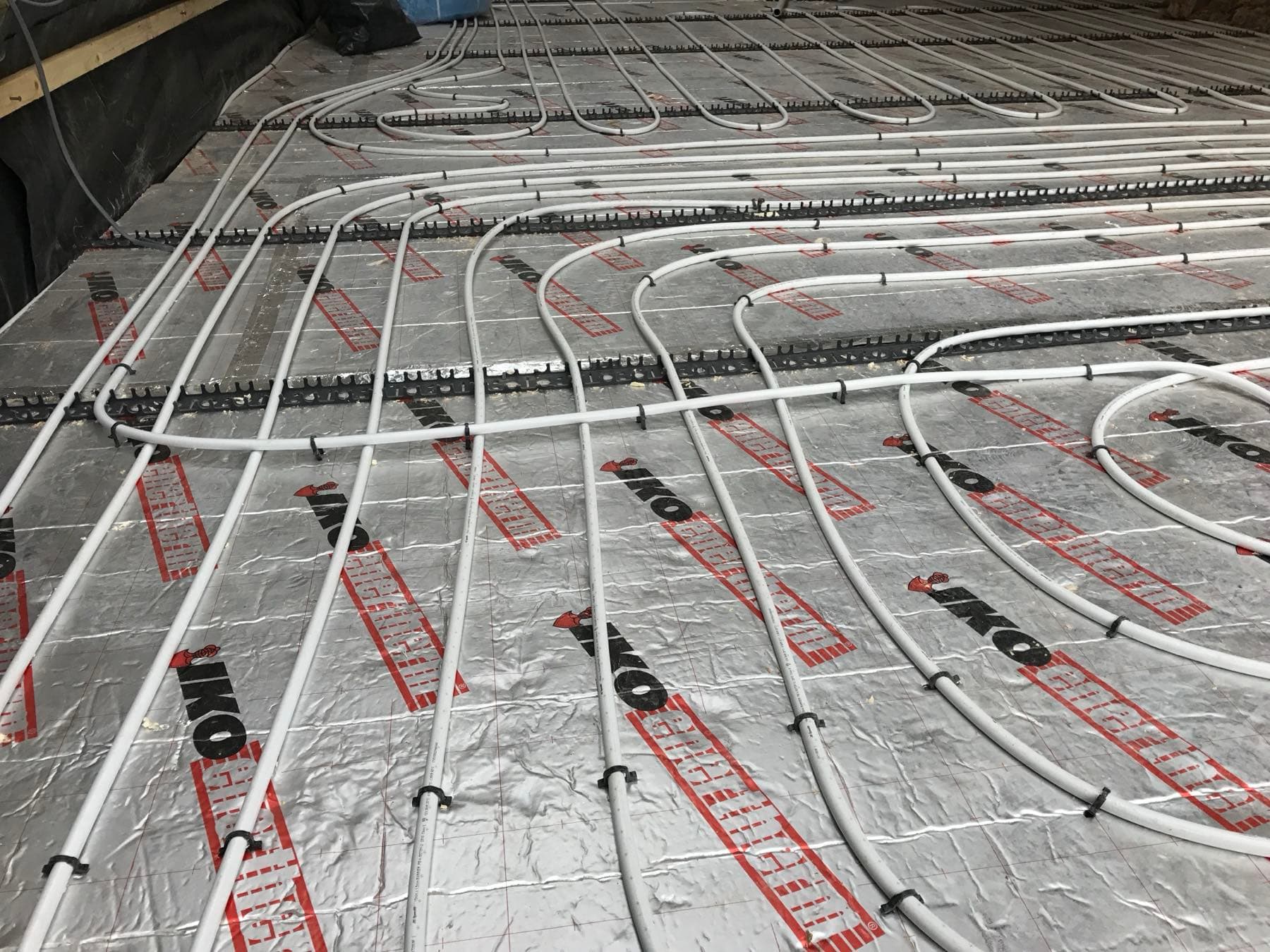
How Wet Underfloor Heating Works
Four parts, and once you know them you can read any system in the country.
The loops
Plastic barrier pipe laid back and forth across the floor, one unbroken length per loop with no joints under the floor. A room is one loop or several depending on its size, because a loop that is too long loses too much heat before the water gets back.
The manifold
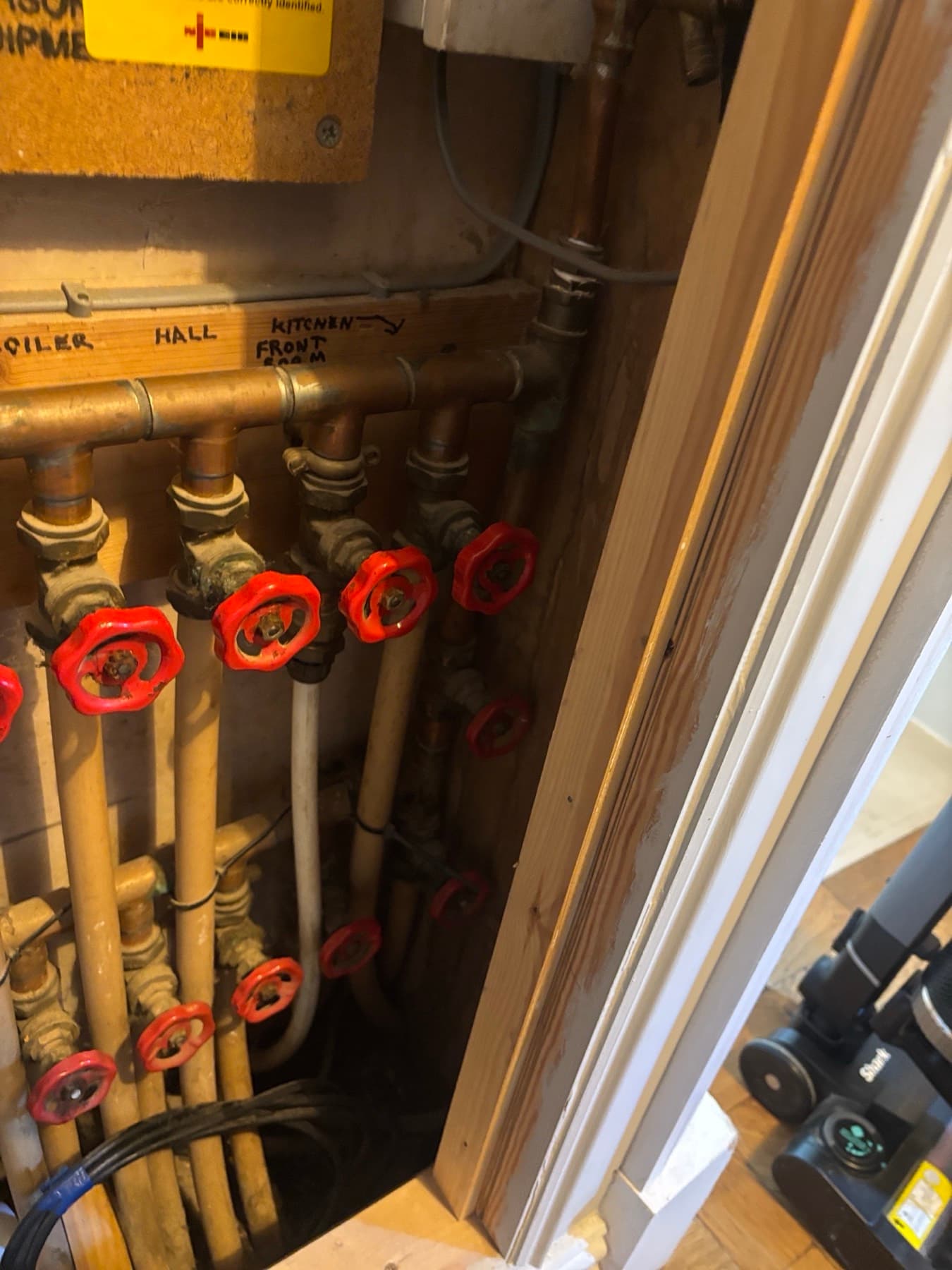
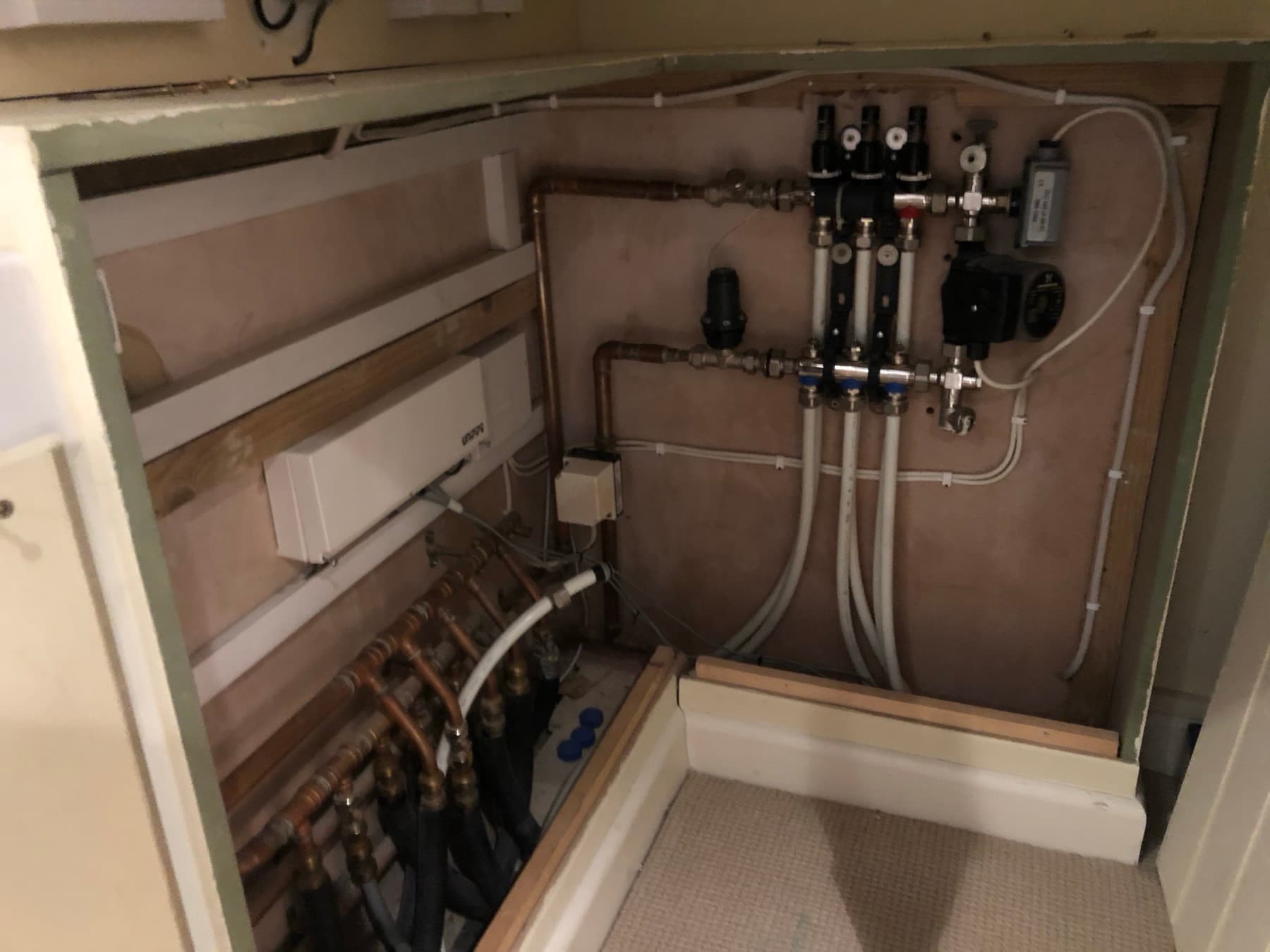
Two bars on the wall, flow and return, with every loop connected to both. A flow meter on each loop shows how much water it is getting and lets you set it. This is where the whole system is adjusted, and where nearly every fault shows first.
The blending valve and pump
Radiator water is too hot for a floor, so a thermostatic blending valve mixes return water back in to drop it to floor temperature, and a small circulator pump moves it round the loops. On a heat pump system the water may already be at floor temperature and the blending valve has little to do.
The controls
A room thermostat per zone, a wiring centre that turns each loop's actuator on and off, and a call for heat back to the boiler or heat pump. This part is electrical and a qualified electrician wires it; I do everything in the previous three boxes.
Why the low temperature matters
A radiator wants water at sixty or seventy degrees. A floor works at thirty-five to forty-five, because the whole floor is the emitter and a small temperature difference over a big area moves plenty of heat. That is exactly where an air source heat pump is efficient, and where a condensing boiler condenses properly. It is the reason a heat pump and underfloor are so often talked about together: they are a good match, not a package you have to buy.
Three Ways to Fit It, and One I Do Not
The question is never really "can I have underfloor" but "what is under your floor now". That decides which of these you get.
| System | What it is | Best for | Watch out for |
|---|---|---|---|
| Screeded | Pipe clipped to insulation and buried in a screed, so the slab itself becomes the radiator. | Extensions, new builds, any floor being poured anyway. The best partner for a heat pump. | The screed sets the timetable: weeks to cure before the heating can go on. |
| Low-profile overlay | Grooved panels laid over the existing floor with the pipe pressed in, a couple of centimetres of build-up. | A solid floor in an existing house where breaking out the slab is not on. | Doors, skirting and thresholds get trimmed, and output is lower than a screeded floor, so the heat-loss sum matters more. |
| Between-joist | Aluminium spreader plates fixed between the joists with the pipe clipped into them, so the boards above become the heated surface. | Upstairs, and suspended timber ground floors with access from above or below. | Insulation must go under the plates or the heat warms the void, not the room. |
| Electric mat | A heating cable on a mesh, laid in tile adhesive. No water involved. | A single small bathroom floor where the running cost of a small mat is acceptable. | Expensive to run over a whole floor. An electrician's job from start to finish, and not one I do. |
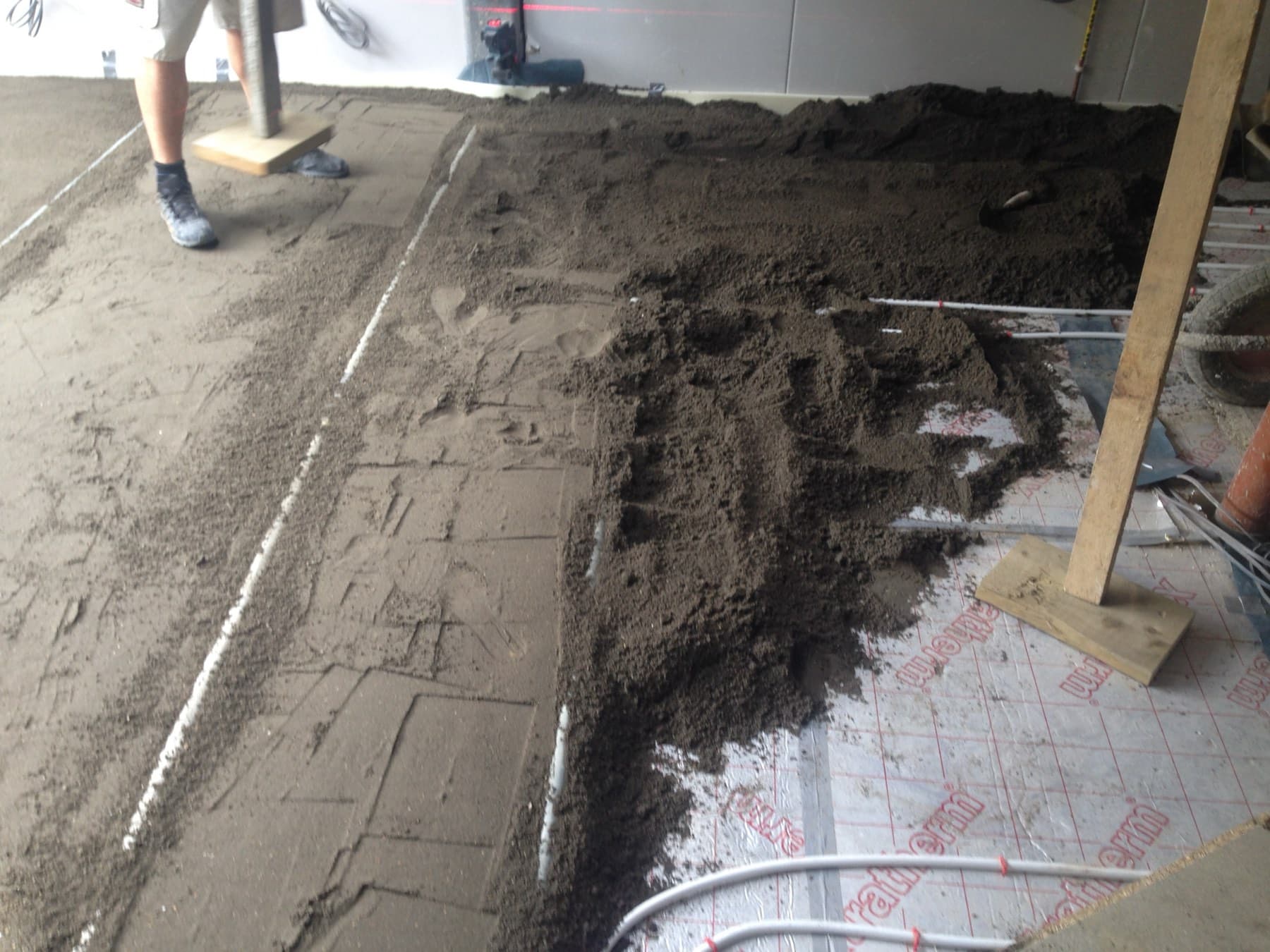
The screed is the point of no return
Once this goes down there is no getting at the pipe. That is why each loop is one unjointed length, and why the whole system sits under test pressure while the screeders work: a nick from a trowel shows on the gauge while it is still a ten-minute repair, not as a damp patch a year later.
It is also why the survey matters more here than on almost any other job I do. A radiator can be swapped if the sum was wrong. A floor cannot.
What Decides the Price
I do not put a from-price on a new underfloor system, and I would be wary of anyone who does without seeing the floor. A kitchen extension on a fresh slab and a whole ground floor over an old suspended timber one are not the same job even if the square metres match. The written price comes from the drawing, and the drawing comes from the survey. These are the things that move it:
Moves the price most
- • Which of the three systems the floor needs, and whether anything has to come up first
- • Floor area and how many loops it takes, because every loop is a manifold port, a flow meter and an actuator
- • Insulation: what is there, what has to go in, and how much height you can give up
- • The screed itself, if there is one, and who lays it
Moves it less than people expect
- • The pipe. Barrier pipe is not the expensive part
- • The manifold, within reason: a good stainless one with flow meters is worth having and not a large share of the total
- • Connecting to the existing heating, unless the manifold has to sit a long way from it
- • Room thermostats, which are the electrician's line rather than mine
The work on an existing system is priced
Once a system is in, the jobs on it are ordinary and so are the prices. A loop flush for a cold loop is from £450 + VAT, the same line as a radiator power flush. A pump, blending valve or actuator swap is from £185 + VAT with the part on top. A balancing or fault-finding visit is from £150 + VAT. A manifold replacement is quoted, because how many loops it has and what state the old connections are in decide it.
All prices exclude VAT. Every one of them is agreed in writing before I start, and the work carries a 12-month workmanship guarantee. The pipe and manifold carry their own manufacturer warranty on top.
When a Room Goes Cold: Read the Manifold
The pipe under the floor almost never fails. When underfloor stops working it is nearly always at the manifold, which is the one part you can get at. Open the cupboard and look before you ring anyone, because what you see tells you most of the answer.
| What you see | Likely cause | The fix |
|---|---|---|
| One flow meter reads nothing while the others move | A stuck actuator, a meter wound shut, or an airlocked loop | Actuator freed or replaced, meter reset, loop vented at the manifold |
| Meter reads normally but the room stays cool | A long loop set to the same flow as the short ones, or sludge in the low point of the pipe | Balance the flow meters loop by loop; if that does not do it, a loop flush |
| Every meter reads nothing | The pump has stopped, or there is no call for heat reaching the manifold | Pump checked and swapped if dead; if the pump is fine, that is the controls, and the electrician |
| Floor is warm in stripes | Flow too low for the pipe spacing, or a blending valve set too cool | Blending valve and flow rates set, then left alone to settle |
| Whole floor lukewarm on the coldest days only | The floor was sized to the room's heat loss with nothing in hand, or the insulation under it is thin | Honest conversation. Sometimes a radiator or towel rail alongside is the right answer |
Commissioning, Screed and What Goes on Top
Most underfloor disappointment is not the system. It is the three weeks after it was fitted, when somebody was in a hurry.
1. Let the screed cure
The screed manufacturer's cure time comes first, and for a traditional sand and cement screed that is measured in weeks, not days. A flowing anhydrite screed has its own regime and its own surface preparation before tiling. The heating does not go on to speed either of them up.
2. First heat-up, slowly
The blending valve starts low and comes up a few degrees a day to working temperature, holds there, then comes back down. A slab shocked from cold to hot cracks, and the crack goes through the tiles above it. I write the dates and temperatures on the commissioning sheet so the floor fitter has them too.
3. Balance, then leave it alone
Each flow meter set so a long loop and a short loop each get what they need, actuators checked against their thermostats, and the settings written down. A balanced floor is then slow to respond and steady, which is the whole point. It is not a system to fiddle with daily.
4. Then the floor finish
Tile and stone are the natural partners and give the most heat through. Engineered wood works within the temperature limit its maker sets, and solid wood is a gamble I would talk you out of. Carpet works with a low-tog underlay; a thick underlay is a duvet over the radiator. Vinyl and laminate both have maximum floor temperatures on the box, and those are the number the blending valve gets set to.
Running It Well
Do
- • Leave it on low and steady through the heating season. A screeded floor takes hours to respond, so on-off timing like a radiator system just leaves you cold at breakfast
- • Use setback, not off: a couple of degrees lower overnight rather than switching the zone off
- • Keep the inhibitor up. The water in the loops is the same heating water as the rest of the house, and sludge settles in the lowest pipe, which is the floor
- • Have the manifold looked at when the boiler or heat pump is serviced: vent it, check the flow meters, glance at the pump
Do not
- • Turn the blending valve up because a room is cold. That is a balancing or flow problem and hotter water only cooks the floor finish
- • Put rugs with rubber backs over large areas of a heated floor; they trap the heat and the floor under them can overheat
- • Let a builder screw into the floor without the loop drawing in their hand. It happens, and it is the one fault that does mean lifting the floor
- • Lose the commissioning sheet. Flow settings, blending temperature and loop lengths are the only record of how the system was set up
A local note on the water
Everyone in Andover, Marlborough and Hungerford knows the water is hard, and people ask whether that scales up an underfloor system the way it scales a kettle. Less than you would think: the heating circuit is sealed and the same water goes round for years, so the scale in it is limited to what came in on the day it was filled. What does matter is corrosion. A sealed system with no inhibitor makes magnetite, magnetite settles at the lowest point, and on an underfloor system the lowest point is the loops. Inhibitor and a magnetic filter are the whole defence, and they are cheap.
Frequently Asked Questions
Can wet underfloor heating be fitted in an existing house?
Yes. A low-profile overlay system sits on top of a solid floor and adds a couple of centimetres, so doors and skirting are trimmed rather than the slab dug up. On a suspended timber floor the pipe goes between the joists on spreader plates. Only an extension or a floor that is being poured anyway gets the full screeded system.
Is underfloor heating cheaper to run than radiators?
It runs at a lower water temperature, which is where a heat pump and a condensing boiler are both most efficient, and a warm floor feels comfortable at a lower air temperature. Whether that adds up to a lower bill depends on the insulation under the floor and how the controls are set. Left on low and steady it usually does; switched on and off like a radiator system it usually does not.
Why has one room on my underfloor heating gone cold?
Look at the manifold. If that loop's flow meter reads nothing, the actuator on it is stuck, the meter has been wound shut, or the loop is airlocked. If the meter reads the same as the others and the floor is still cool, the loop needs a higher flow rate than the short ones or there is sludge lying in the low point of the pipe. Balancing fixes the first, a loop flush fixes the second.
How long after screeding can the heating go on?
The screed manufacturer's cure time comes first, and for a traditional sand and cement screed that is weeks. A flowing anhydrite screed has its own drying regime. Then the first heat-up is gradual, a few degrees a day up to working temperature and back down, so the slab is not shocked into cracking. The floor finish goes down after that.
Does underfloor heating need an electrician as well as a plumber?
On a new wet system, yes for one visit: the wiring centre, the room thermostats and the actuators are electrical and a qualified electrician wires and certifies them. The pipework, manifold, pump and blending valve are the plumber's. Electric mat systems are electrical work from start to finish and are not something I fit.
Thinking About Underfloor, or Living With One That Has Gone Cold?
Free survey, the manifold read loop by loop, and a written fixed price for whatever it actually needs. Andover, Marlborough and Hungerford.
Related Guides
Central Heating Sludge Removal Guide
What magnetite is, why it settles in the lowest pipe, and chemical flush against power flush.
Read Guide →Central Heating Pump Guide
Grundfos, Wilo and DAB compared, and the signs the pump rather than the loops is the problem.
Read Guide →Radiator Cold Spots: Air, Sludge or Valve?
The same three culprits stop a radiator, and the same tests tell them apart.
Read Guide →Radiators not doing their job?
Wet-side heating work from £150 + VAT
Cold spots, sludge, a radiator moved or added, power flushing. I am not Gas Safe — the boiler itself is a gas engineer’s job and I will say so rather than guess.