
Underfloor
Heating
The water side of underfloor heating across Andover, Marlborough and Hungerford: loops laid and pressure-tested, old manifolds replaced, cold loops flushed and balanced. Fixed price in writing before I start.
Underfloor Services
A new floor or a new manifold is priced from the drawing, because the number of loops and what is under the floor decide the job. The flush, the part swaps and the visits are the figures in the job system. Everything goes in writing before a floor comes up.
New Wet Underfloor System
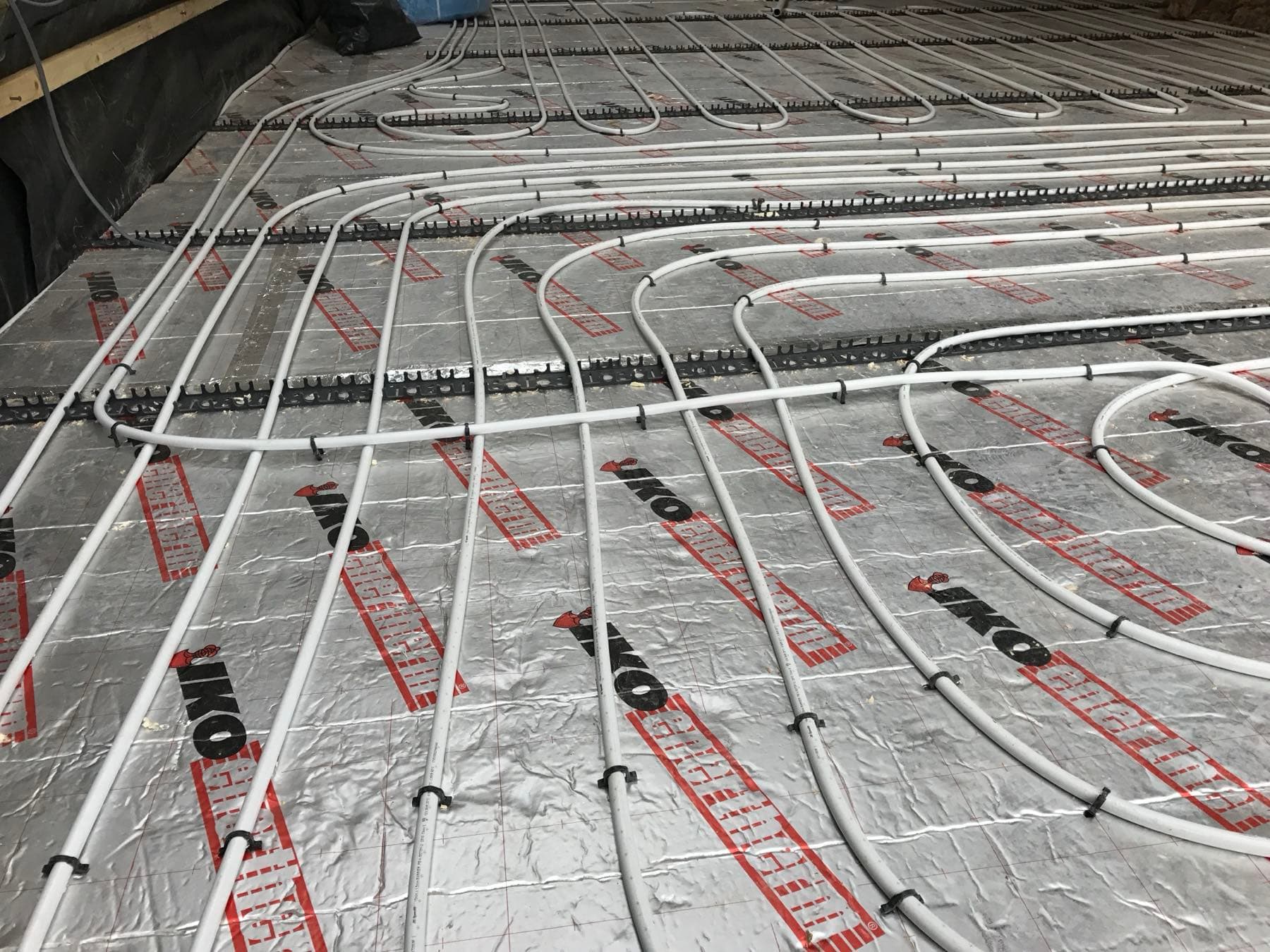
Pipe loops laid on insulation and run back to a manifold with a flow meter on every loop, a blending valve and a pump. Every loop is pressure-tested before the screed goes down and the whole thing is commissioned once it has cured. Priced from the drawing after a survey, because a kitchen extension and a whole ground floor are not the same job.
What's Included:
- Heat loss and loop layout worked out first
- JG Speedfit or Wavin pipe and manifolds
- Every loop pressure-tested before the floor goes down
- Blending valve set to floor temperature, not radiator temperature
- Commissioned and balanced loop by loop
- 12-month workmanship guarantee
Manifold Replacement and Upgrade
An old copper manifold with a gate valve on every loop and no way of seeing what is flowing where, swapped for a stainless manifold with a flow meter and isolation valve per loop, a blending valve and a pump. Same loops under the floor, new brain on the wall.
What's Included:
- Old gate valves and copper bars out
- Stainless manifold, flow meter on every loop
- Blending valve and pump fitted or reused if sound
- Loops flushed before they are reconnected
- Balanced and labelled so the next person can read it
Underfloor Loop Flush
A loop that runs lukewarm, or stays cold while the others heat, is usually sludge lying in the lowest run of pipe. Each loop is isolated at the manifold and flushed on its own until the water runs clear, then the system is dosed with inhibitor so it stays that way.
What's Included:
- Each loop flushed one at a time
- Magnetite and sludge pumped out
- Inhibitor dosed afterwards
- Magnetic filter fitted if there is none
- Flow rates checked at every meter before I leave
Balance and Commission
Flow meters set loop by loop so a long lounge loop and a short hallway loop each get what they need, the blending valve set, the actuators checked against their thermostats, and the first heat-up on a new screed done gradually so the slab does not crack.
What's Included:
- Flow meter set on every loop
- Blending valve set to the floor build-up
- Actuator heads checked against each stat
- Gradual first heat-up on a new screed
- Settings written down and left with you
Pump, Blending Valve and Actuator Swaps
The pump on a manifold is a standard circulator, and the blending valve and actuator heads are off-the-shelf parts. When one fails it is a like-for-like swap in a morning, with the part on top of the labour figure.
What's Included:
- Grundfos or Wilo manifold pumps
- Thermostatic blending valves
- Actuator heads matched to the manifold
- Auto air vent and fill valve replaced if seized
Fault-Finding: Cold Loop or Cold Room
A room that never gets warm, a loop showing nothing at the flow meter, a floor that is warm in stripes. Air, a stuck actuator, a closed meter, a tired pump and a sludged loop each show differently at the manifold, and the visit finds which before anything is bought.
What's Included:
- Flow checked at every meter
- Actuator heads checked for movement
- Air bled from the manifold and loops
- Straight answer on flush, part or leave alone
- Any repair quoted in writing
How a Wet Underfloor System Goes In
Heat Loss and Layout
Each room's heat loss worked out, then the loops drawn: pipe spacing, loop lengths kept even, and the manifold put where the runs are shortest and you can get at it.
Insulation and Loops
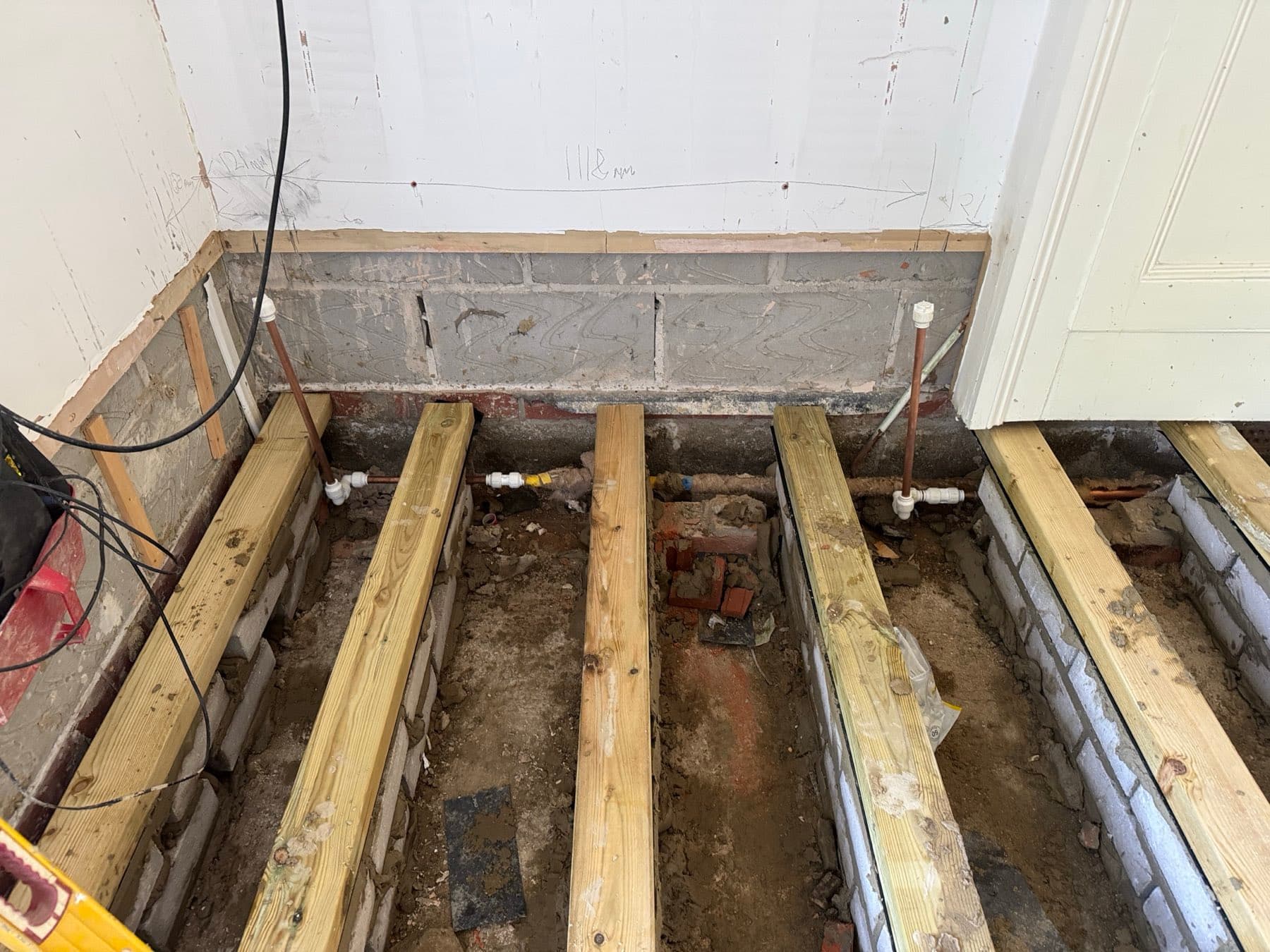
Insulation down first so the heat goes up into the room and not into the ground, edge strip round the walls, then the pipe clipped or pressed into panels loop by loop, each one a single length with no joints under the floor.
Test, Then Screed
Every loop pressure-tested and left under pressure while the screed goes down, so a nick from a trowel shows on the gauge and not as a wet patch a year later.
Commission and Balance
Once the screed has cured: flow meters set loop by loop, blending valve set, actuators checked against the stats, and a gradual first heat-up written on the sheet you keep.
Expert Underfloor Heating

Expert Underfloor Heating by Will Gaze
Underfloor is pipework, a manifold and a pump, which is to say it is plumbing, and after 22+ years on the wet side of heating it is the part of a build I most like getting right. A floor cannot be adjusted once the screed is down, so the sums and the pressure test happen before it, not after.
I am not Gas Safe or OFTEC registered and I do not touch gas or oil boilers; if the heat source is the problem I will say so and point you to an engineer who is. I am G1 trained on air source heat pumps, which matters here because a floor is the best thing a heat pump can be connected to, and I design for that flow temperature from the start. Fixed price in writing, one plumber start to finish, 12 months on the work.
Which Underfloor?
What is under your floor decides it. Three of these are mine; the fourth is an electrician's, and I will tell you when it is the right answer anyway.
Screeded Wet System
Pipe clipped to insulation and buried in the screed, so the whole slab becomes the radiator. The highest output and the most even heat of the four, and the one that suits a heat pump best because the mass of the floor holds the warmth.
Best for: extensions, new builds and any floor that is being poured anyway.
Watch out for: drying time. The screed sets the programme, and the heating cannot go on until it has cured.
Low-Profile Overlay Wet System
Grooved panels laid over the existing floor with the pipe pressed in, a couple of centimetres of build-up. Fast to fit and the floor finish goes straight on top.
Best for: a solid floor in an existing house where breaking out the slab is not on.
Watch out for: it raises the floor, so doors, skirting and thresholds get trimmed, and the output is lower than a screeded system, so the heat-loss sum matters more.
Between-Joist Wet System
Aluminium spreader plates fixed between the joists with the pipe clipped into them, so the boards above become the heated surface. Nothing changes in the floor height.
Best for: upstairs, and suspended timber ground floors with access from above or below.
Watch out for: insulation has to go in under the plates or the heat warms the void instead of the room.
Electric Mat
A heating cable on a mesh mat laid in tile adhesive. Cheap to buy and thin, which is why it wins in a small bathroom, and dear to run, which is why it loses everywhere else.
Best for: a single bathroom or small en-suite floor where the running cost of a small mat is acceptable.
Watch out for: expensive to run across a whole floor. I do not fit it; the connection is notifiable electrical work and a qualified electrician does it and certifies it.
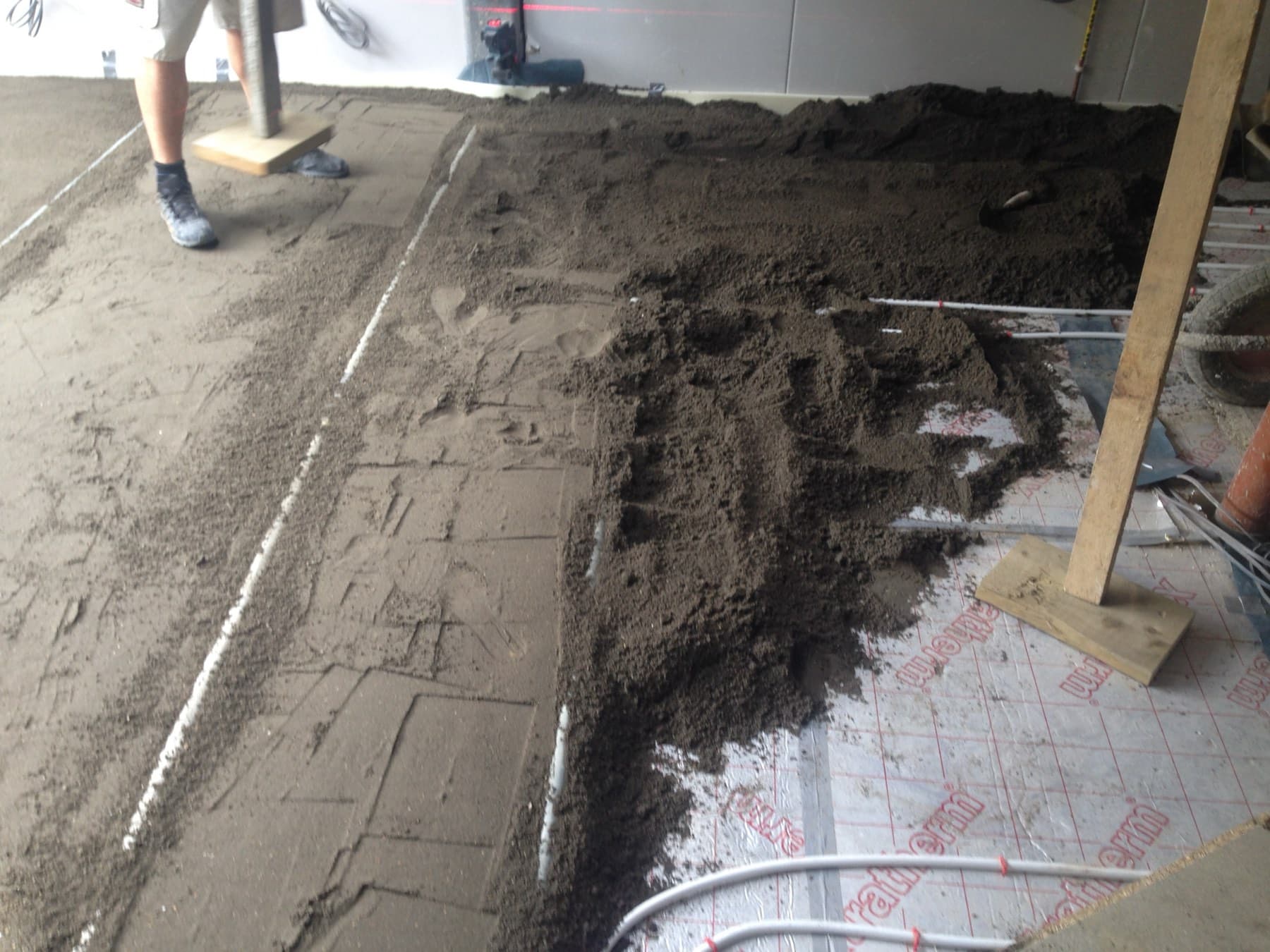
The Screed Is the Point of No Return
Once this goes down there is no getting at the pipe, which is why every loop is a single unjointed length and why the whole system sits under test pressure while the screeders work. If the gauge drops, the pipe is found and fixed while it is still a ten-minute job.
The screed then sets the timetable. It cures at its own pace, the first heat-up is gradual, and the flooring goes on last. Rushing any of those three is how a floor ends up cracked or a wood floor ends up cupped.
Where Underfloor Goes Wrong
The pipe under the floor almost never fails. The manifold on the wall is where the problems live, and it is the one part you can get at.
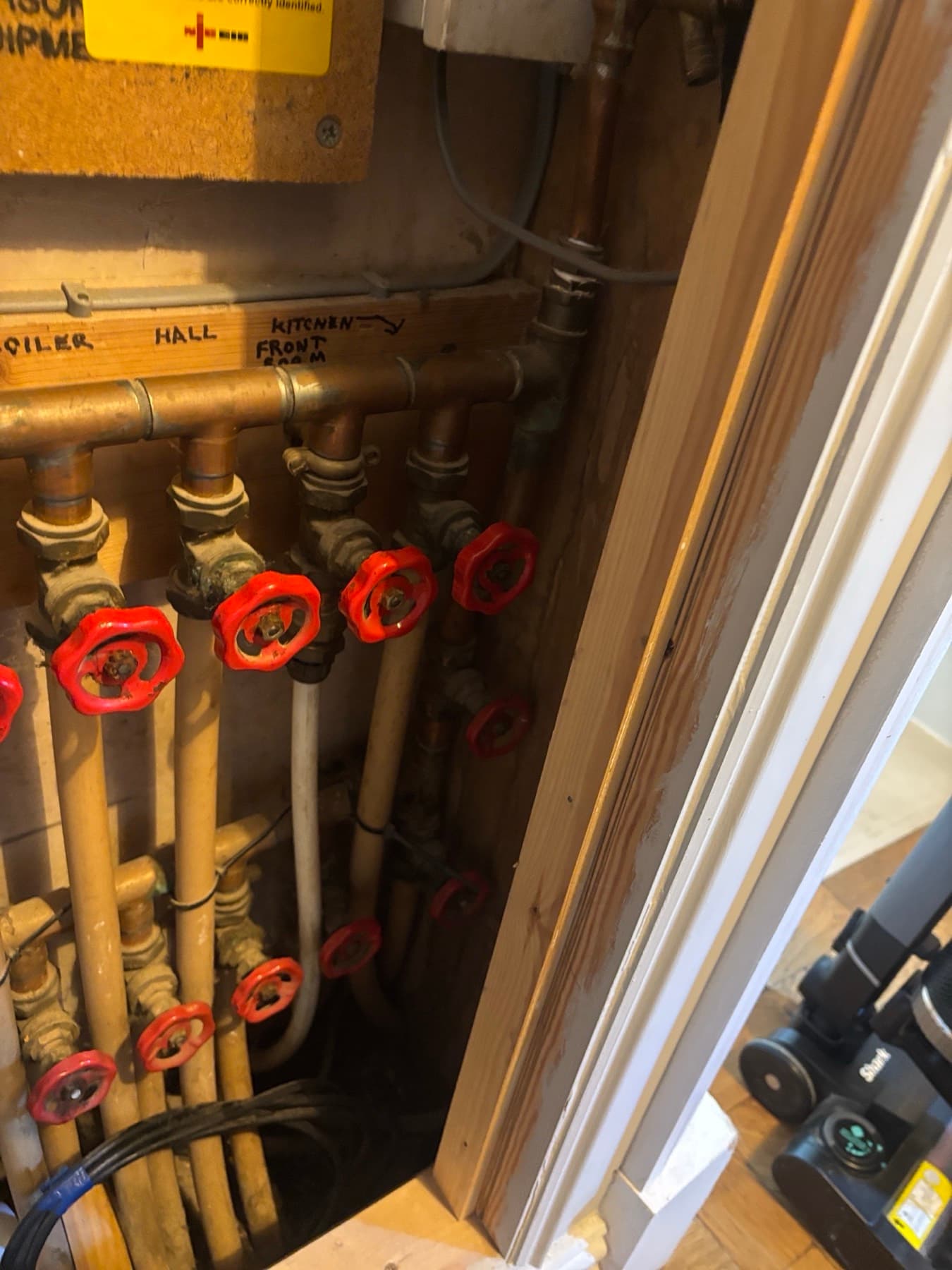
What a manifold upgrade replaces
Copper bars, a red-wheel gate valve on every loop and the room names written on the wall in pen. No flow meters, so nobody can tell what any loop is getting, and gate valves that have not been turned in twenty years do not turn now.
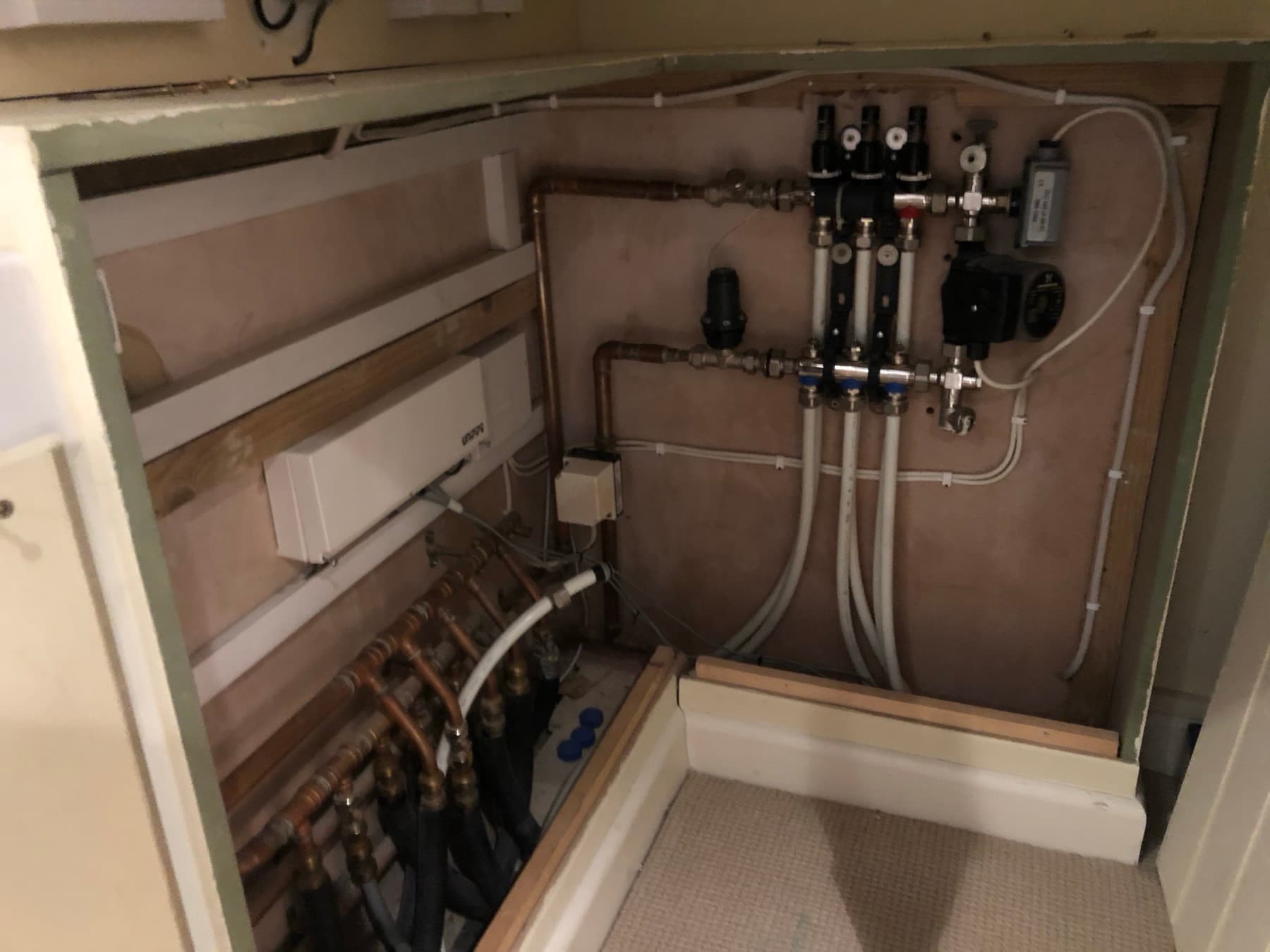
What it looks like done properly
Stainless flow and return bars, a flow meter on every loop, the blending valve that drops the water to floor temperature and the pump that moves it round. The white tails go out to the loops; the copper below is the feed from the rest of the heating.
Watch: an Underfloor Loop Flush
This is what the loop flush above looks like on a job. Each loop is isolated at the manifold and flushed on its own, and the colour of what comes out is the whole argument for doing it.
A loop that has gone cold at the far end is nearly always this, not a fault in the pipe, which is why a flush is the first thing to try and a new floor the last.
Underfloor Service Areas
One plumber working out of Wootton Rivers. A manifold visit is a half day anywhere below; a new floor goes in the diary around the builder's programme.
Andover and Test Valley
Down the A338 and A342 from Wootton Rivers
- Andover (SP10, SP11)
- Upper Clatford and the Wallops
- Stockbridge and Chilbolton (SO20)
Marlborough and Pewsey Vale
Kitchen extensions and barn conversions, and the old manifolds that came with them
- Marlborough and Ramsbury (SN8)
- Great Bedwyn and Burbage (SN8)
- Pewsey and Upavon (SN9)
- Tidworth and Ludgershall (SP9, SP11)
Hungerford and Lambourn Valley
The Kennet valley, over the Berkshire border
- Hungerford (RG17)
- Lambourn and Great Shefford
- Kintbury, Inkpen and Combe
- Chilton Foliat and Shalbourne
Booking an Underfloor Visit
A flush, a balance or a part swap is a half-day slot. A new floor or a manifold change is surveyed first and booked as the days it needs, timed with the screeders or the builder. Same-day or next-working-day for most jobs; emergency slots subject to availability. You get a named date when Will confirms the booking.
Heating Guides
The full underfloor guide, the pump that pushes it round, and the sludge that stops a loop.


Frequently Asked Questions
Can wet underfloor heating go into an existing house?
Yes, and it does not always mean digging the floor up. On a solid floor a low-profile overlay system sits on top of what is there and adds a couple of centimetres, so doors and skirting get trimmed rather than the slab broken out. On a suspended timber floor the pipe runs between the joists on spreader plates, from above with the boards up or from below if there is a cellar or void. A screeded system is the one for an extension or a floor that is being poured anyway. The survey tells you which of the three you have and what each costs before anything is lifted.
Does underfloor heating work with a heat pump?
It is the best partner a heat pump has. A radiator system wants water at sixty or seventy degrees; a floor works at thirty-five to forty-five, which is exactly where a heat pump is efficient. I am G1 trained on air source heat pumps, so a floor I lay now is designed for that flow temperature even if the heat source is still a boiler today. The heat pump itself is fitted by an MCS registered installer, which I am not; the floor, the manifold and the pipework back to it are mine.
Why does one room never get warm when the rest of the house does?
Look at the manifold first. If that loop's flow meter reads nothing, the actuator on it is stuck, the meter has been wound shut, or the loop is airlocked. If it reads the same as the others but the floor stays cool, the loop is long and the flow rate needs setting higher than the short ones, or there is sludge lying in the low point of the pipe. Balancing fixes the first kind and a loop flush fixes the second, and the fault-finding visit works out which before you spend money on either.
Do I need an electrician as well?
Sometimes. The pump, the actuators and the wiring centre that ties the room thermostats to them are electrical, so on a new system that part is wired by a qualified electrician who issues the certificate, and the two visits are booked together. Electric mat systems are electrical work from start to finish and I do not fit them. I am not Part P registered and will not pretend otherwise. A like-for-like pump or actuator swap on an existing manifold is a plug-and-play part and does not need a second visit.
How long after the screed goes down can the heating go on?
The screed manufacturer's cure time comes first, and for a traditional sand and cement screed that is weeks, not days. A flowing anhydrite screed is different again and has its own drying regime. Then the first heat-up is done gradually: the blending valve is set low and raised a few degrees a day up to working temperature and back down, so the slab is not shocked into cracking. The flooring goes down after that, not before. I write the dates and the temperatures on the commissioning sheet so the floor fitter has them too.
Important Booking Information
Our professional booking system ensures seamless service delivery from first contact to job completion
Your Call Gets Answered
In Your PA answers the landline in office hours, so somebody picks up when Will is under a sink. They take your details and pass them straight through. Will is the one who quotes the job and turns up to do it.
Arrival Windows
We provide time windows rather than exact times to ensure quality work on each job. We'll keep you updated with a more precise ETA.
ServiceM8 System
Our professional job management system provides SMS updates, online booking, and digital job records for a seamless experience.
What I Fit, and Where It Comes From
Pipe, panels and manifolds are JG Speedfit or Wavin through Plumbfix and Trade UK, because both are barrier pipe with a long warranty and both make a manifold with a proper flow meter on every loop. Manifold pumps are Grundfos or Wilo, the same circulators that run the rest of a heating system.
If your builder or architect has specified a particular system, I will fit that and tell you honestly if I think the spec is wrong for the floor. You keep the manufacturer warranty on the pipe and the manifold; the workmanship is mine.
See all the brands I work with

A Floor That Never Gets Warm?
Free survey, the manifold read loop by loop, and a written price for whatever it actually needs before any work starts.