
Vented vs Unvented vs Heat Pump Cylinder
Three types of hot water cylinder, three different ways of working. Here is the honest comparison from a plumber who installs all three across Andover, Marlborough and Hungerford.
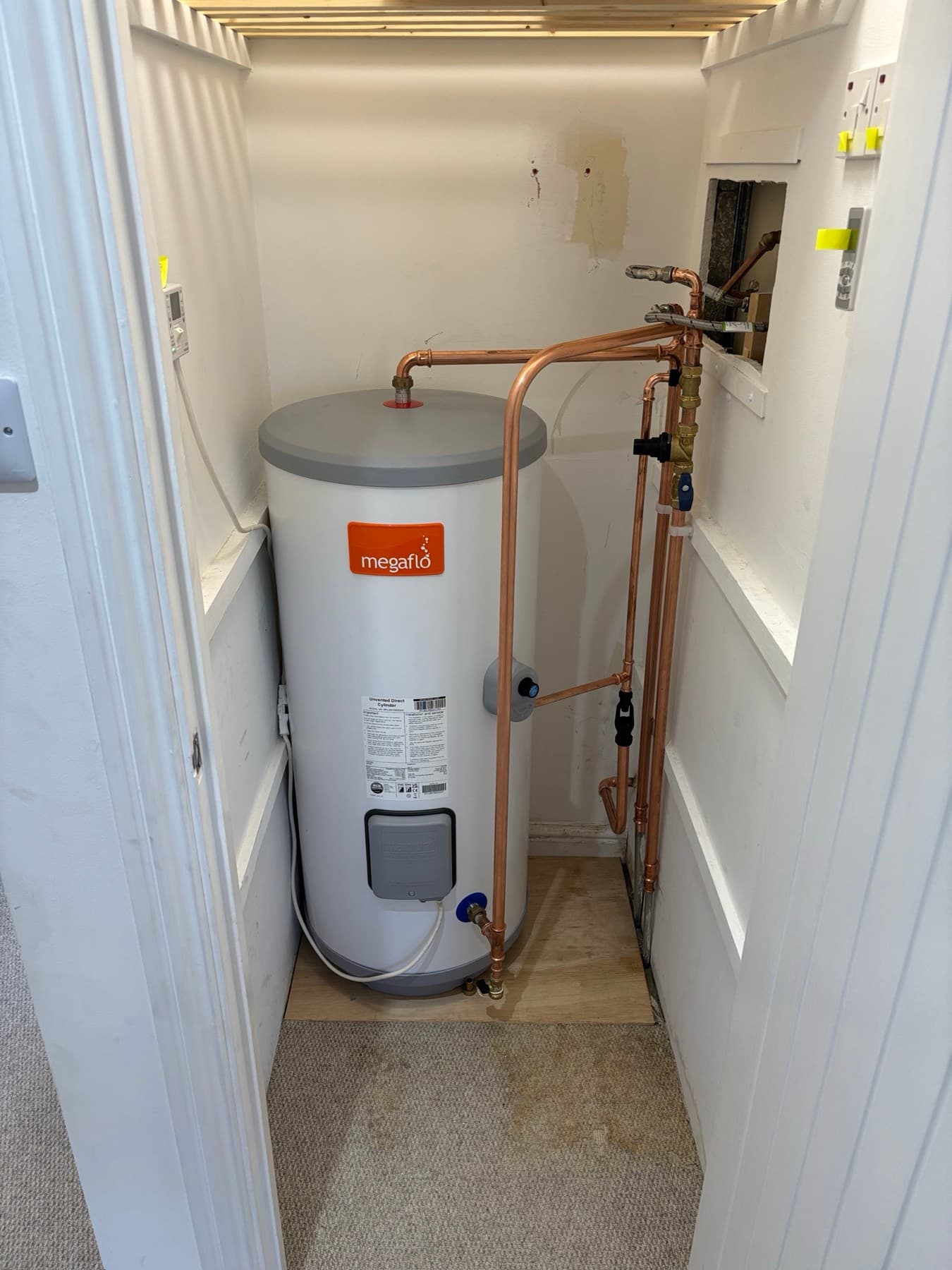
Most homes around Andover, Marlborough and Hungerford store their hot water in a cylinder. The question is which kind. There are three main types on the market today, and each one suits a different situation. Getting the wrong one means either overpaying for features you do not need, or living with poor water pressure and wishing you had spent a bit more.
I install all three types. I am G3 qualified for unvented cylinders and G1 ASHP trained for heat pump cylinder work. This guide lays out how each cylinder works, what it costs, and which one makes sense for your home.
Vented (Gravity-Fed) Cylinders
A vented system uses a cold water storage tank in the loft. Cold water feeds down by gravity into the cylinder, where your boiler or immersion heater warms it. When you open a hot tap, the pressure comes from the height of the tank above it. That is why upstairs taps often have reasonable flow but a ground-floor shower can feel underwhelming.
The system is called "vented" because it is open to atmospheric pressure through the vent pipe that runs back up to the loft tank. If the water overheats, it simply vents safely into the tank rather than building dangerous pressure. This simplicity is the system's main strength.
Pros
- +Lowest purchase and installation cost (from around £800 installed)
- +Simple technology with very little to go wrong
- +Any competent plumber can install and service it
- +No annual service requirement
- +Works even with low mains water pressure
Cons
- -Lower water pressure, especially downstairs, unless you add a pump
- -Needs a cold water tank in the loft, taking up space
- -Loft tank needs insulating and occasional maintenance
- -Risk of tank freezing in a cold winter if insulation is poor
- -Not compatible with some modern showers that need higher pressure
When I recommend vented: If your home already runs a vented system and you are happy with the water pressure, a like-for-like replacement is the simplest and cheapest option. I also recommend vented where mains pressure is too low for an unvented system, which does happen in some of the more rural villages around SN8 and RG17.
Unvented (Mains-Pressure) Cylinders
An unvented cylinder connects directly to the incoming mains water supply. Because it is a sealed, pressurised vessel, the hot water comes out at the same pressure as your cold mains. That means strong, even flow from every tap and shower in the house, upstairs or down.
The trade-off is complexity. Because the system is sealed, it needs multiple safety devices: a temperature and pressure relief valve, an expansion vessel, a check valve to stop heated water pushing back into the mains, and a tundish in the discharge pipework. Building Regulations require all of this, and they require a G3-qualified engineer to install it.
I hold current G3 certification and install unvented cylinders across Andover, Marlborough, Hungerford, Tidworth, Pewsey, Stockbridge and Great Bedwyn. Every installation is notified to Building Control as required.
Pros
- +Mains-pressure hot water at every outlet
- +No cold water tank in the loft, freeing up space
- +Balanced pressure between hot and cold simplifies mixer valves
- +Can supply multiple showers running at the same time
- +Cleaner water supply, drawn straight from the mains
Cons
- -Must be installed by a G3-qualified engineer (a legal requirement)
- -Annual service recommended to check safety valves and expansion vessel
- -Higher purchase price than a vented cylinder (from around £1,500 installed)
- -Needs adequate mains pressure (at least 1.5 bar) to work properly
- -Discharge pipe must run to a safe external point
When I recommend unvented: If your mains pressure is good (1.5 bar or above) and you want strong, consistent hot water throughout the house. It is particularly worth it with multiple bathrooms. Read more on our unvented cylinder installation page.
Heat Pump Cylinders
A heat pump does not burn fuel. It moves heat from outdoor air (or the ground) into water, at relatively low temperatures: typically 45-55 degrees C compared to the 65-80 degrees C a gas or oil boiler produces. A standard cylinder's coil is too small to extract enough heat from this lower-temperature water, so a heat pump cylinder has a much larger coil surface area.
Heat pump cylinders are also bigger overall, usually 200-300 litres rather than the 120-180 litres typical of a conventional system. They need that extra volume because the heat pump heats water more slowly, so the cylinder stores a larger reserve. The insulation is thicker too.
An important distinction: I install the cylinder itself, including all pipework and connections. I am G1 ASHP trained for this work. I do not install the heat pump unit, which is a separate job done by an MCS-certified heat pump installer. Where a customer needs both, I work alongside the heat pump installer so the cylinder is ready when they connect it.
Pros
- +Future-proofs your home for a heat pump installation
- +The Boiler Upgrade Scheme offers £7,500 towards the heat pump system
- +Twin-coil models can work with a boiler now and a heat pump later
- +Superior insulation means less heat loss during storage
- +Larger capacity for more hot water between heating cycles
Cons
- -Higher purchase price (from around £2,000 installed)
- -Physically larger, needs more floor space and headroom
- -No benefit over a standard cylinder if you are not planning a heat pump
- -Heats water more slowly than a boiler-fed system
- -The heat pump unit itself must be installed by an MCS-certified installer
When I recommend a heat pump cylinder: If you already have a heat pump or are planning one in the next few years. A twin-coil model can run from your existing boiler today and switch to the heat pump when it arrives. See our heat pump cylinder installation page.
Side-by-Side Comparison
Guide prices for standard installations in Andover, Marlborough and Hungerford.
| Vented | Unvented | Heat Pump | |
|---|---|---|---|
| Installed From | £800 | £1,500 | £2,000 |
| Water Pressure | Gravity (low) | Mains (high) | Mains (high) |
| Loft Tank | Yes | No | No |
| Qualification | Any plumber | G3 (legal) | G1 ASHP (cylinder) |
| Annual Service | Not required | Recommended | Recommended |
| Typical Capacity | 90-210L | 120-300L | 200-300L |
| Best For | Budget, low mains pressure | Strong showers, multi-bathroom | Heat pumps, future-proofing |
Which Is Right for Your Home?
Choose vented if...
You already have a vented system and the water pressure suits you, your mains pressure is below 1.5 bar (common in rural villages around Hungerford and Marlborough), budget is the main concern, or you have a single bathroom with no plans to add another.
Choose unvented if...
You want strong, consistent pressure at every outlet, you have two or more bathrooms, you want to free up loft space, and your mains pressure is at least 1.5 bar. I check this during the free survey.
Choose a heat pump cylinder if...
You already have or are planning a heat pump, you want to replace the cylinder once rather than twice, you have room for a larger unit, or you are applying for the Boiler Upgrade Scheme and the heat pump installer needs a compatible cylinder fitted.
Not sure? That is what the free survey is for. I come out, check your mains pressure, look at the existing setup, and talk through which option makes sense. No charge and no obligation. Call 01264 502027 or book online. Minimum charge £150 + VAT. For a full cost breakdown, read our cylinder replacement cost guide.
Frequently Asked Questions
What is the difference between a vented and an unvented hot water cylinder?
A vented cylinder is fed by a cold water storage tank in the loft and relies on gravity for pressure. An unvented cylinder connects directly to the mains water supply, delivering higher and more consistent water pressure to every tap and shower. Unvented cylinders must be installed by a G3-qualified engineer by law, while vented cylinders can be fitted by any competent plumber.
Do I need a G3-qualified plumber to install an unvented cylinder?
Yes. Building Regulations (Part G3) require that any unvented hot water cylinder over 15 litres is installed by a G3-qualified engineer. The installer must also notify Building Control. Will Gaze at Rosebourne Plumbing holds current G3 certification and covers Andover, Marlborough, Hungerford and surrounding areas.
What is a heat pump cylinder and how is it different?
A heat pump cylinder is designed to work with air source or ground source heat pumps, which deliver heat at lower temperatures than a traditional boiler (around 45-55 degrees C instead of 65-80 degrees C). To compensate, heat pump cylinders have a much larger internal coil to absorb heat efficiently, thicker insulation to retain it, and are typically 200-300 litres rather than the 120-180 litres common in standard systems.
Can Rosebourne Plumbing install heat pump cylinders?
Yes. Will is G1 ASHP trained for heat pump cylinder installations. Rosebourne installs the hot water storage cylinder itself, including all pipework and connections. Rosebourne does not install the heat pump unit. That is done by an MCS-certified heat pump installer, and we work alongside them.
How much does a new hot water cylinder cost installed?
A vented cylinder costs from around £800 installed. An unvented cylinder costs from around £1,500 installed. A heat pump cylinder costs from around £2,000 installed. These are guide prices for standard installations across Andover, Marlborough and Hungerford. Every job gets a free survey and a fixed written quote before work starts.
Related Guides
Complete Hot Water Cylinder Guide UK 2026
Compare 11 cylinder brands, understand sizing, and learn everything about vented, unvented and heat pump cylinders.
Hot Water Cylinder Replacement Cost UK 2026
Full cost breakdown for vented, unvented and heat pump cylinder replacements with real prices from a local installer.
Hot Water System Installation
Vented, unvented and heat pump cylinder installation across Andover, Marlborough, Hungerford and surrounding areas.
Ready to Choose Your Cylinder?
G3 qualified for unvented. G1 ASHP trained for heat pump cylinders. Free survey, fixed-price quote, 22+ years of experience.
Covering Andover (SP10/SP11), Marlborough (SN8), Hungerford (RG17), Tidworth (SP9), Pewsey (SN9) & Stockbridge (SO20)
Thinking about a new cylinder?
Get a guide price in 30 seconds
Unvented cylinders supplied and fitted from £1,640 + VAT by a G3-qualified plumber. Pick the size and job type, see a price range, no email needed.