
Outside Taps Done Properly: A Plumber's Guide
The check valve the regulations require, the isolation valve that saves the tap every winter, running one to the far end of the garden, and the five minutes in October that stop a burst in January.
An outside tap is the smallest job on this site and the one most often done badly. A hose union tap screwed through a wall onto the nearest cold pipe takes an hour, and for seven months of the year it works perfectly. Then the first hard frost of January finds the one thing that was left out, and you have water running down the inside of a kitchen wall.
This guide is what a proper one involves, why each part is there, how a tap gets to the far end of a garden, and the five minutes every October that make the difference. It is written for Andover, Marlborough and Hungerford, where the water is hard, the houses are old, and the Kennet valley holds a frost.
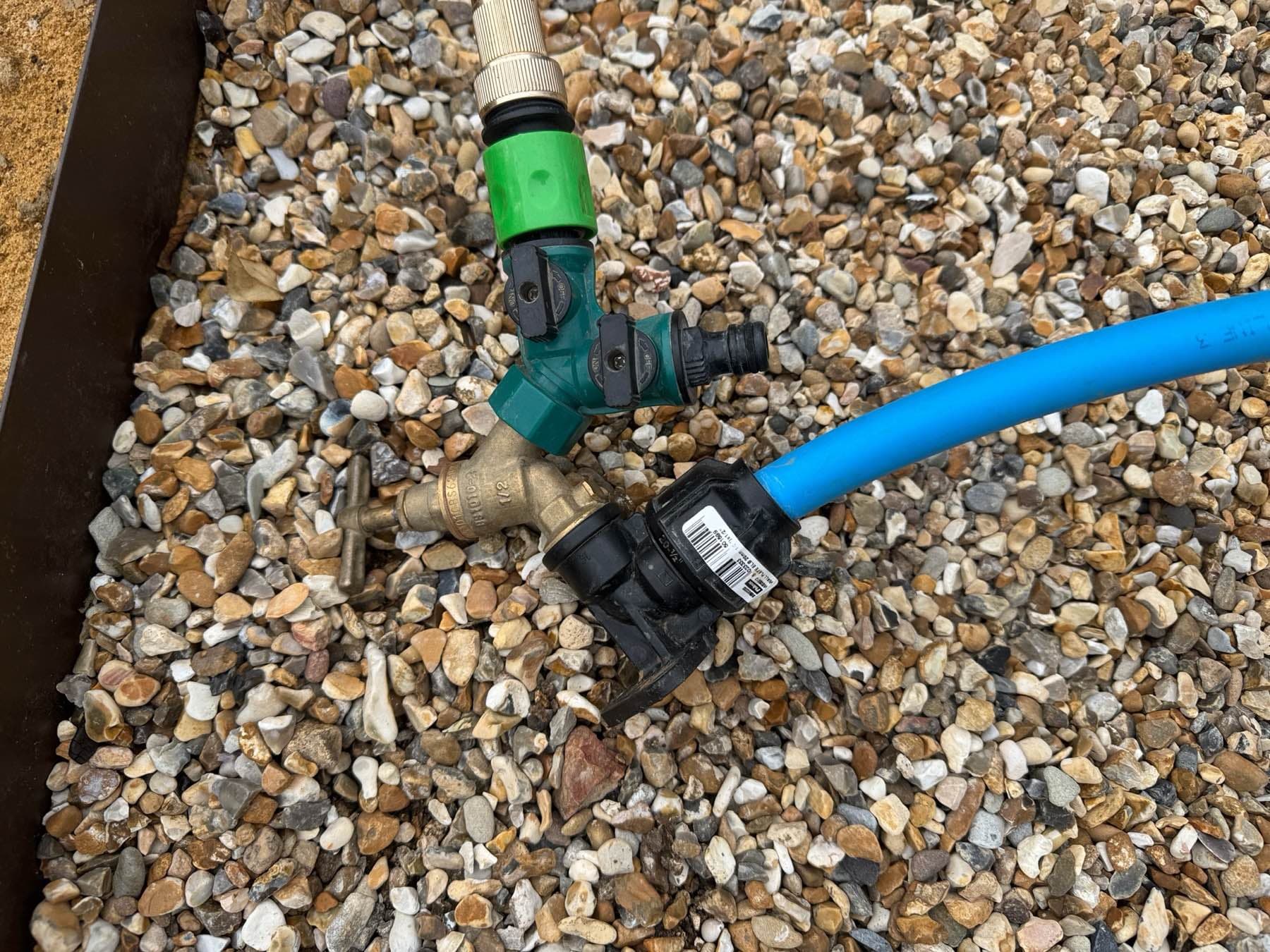
What a Properly Fitted Outside Tap Has
Five parts. The tap itself is the cheapest of them and the only one most people ever see.
1. A double check valve, inside
A hose can end up lying in a water butt, a pond or a bucket of something you would not drink. If the mains pressure drops, that can be pulled back into the pipe that feeds your kitchen tap. The Water Supply (Water Fittings) Regulations require backflow protection on a hose union tap, and the proper way is a double check valve on the supply, inside the house where it cannot freeze. A check valve built into the tap body is a bonus, not the answer: the body is the part that sits in the frost.
2. An isolation valve, inside, where you can reach it
This is the part that saves the tap every winter and the part most often missing. A quarter-turn valve on the supply, somewhere you can get at it without emptying a cupboard, lets you shut the tap off and drain it before the frost. Without it the only way to isolate a split tap is the stopcock for the whole house.
3. The shortest possible run through the wall
The pipe through the wall is the bit that freezes, so it is kept short, sleeved, and sealed at both faces so the cavity does not become a wind tunnel round it. Where the run outside has to be longer, it is insulated, and where it cannot be kept warm it is designed to be drained.
4. A wall plate and a proper fixing
A tap gets leant on, knocked by the mower and yanked by the hose. It is fixed to the wall through a plate, not held up by the pipe through the wall, because a tap held up by its pipe works the joint loose and the joint is on the wrong side of the brick to see.
5. A tap worth having
A plain brass hose union bib tap with a three-quarter inch thread is the standard, and a decent one costs very little. A lever tap is easier with cold hands. The ones to avoid are the plastic-bodied kits sold with a self-cutting connector that clamps onto the pipe inside: the connector weeps, the body splits in the first frost, and the check valve inside it is the only one there is.
A note on the water here
The water across Andover, Marlborough and Hungerford is hard, and an outside tap that drips for a summer grows a stalactite of scale and then will not shut. A tap that is turned fully off, not just until it stops running, lasts far longer, and a washer is pennies to change when it starts. Scale also seizes isolation valves that are never used, which is one more reason to turn yours every autumn.
Through the Wall, or Down the Garden
Two different jobs that share a name. The first is an hour or two; the second is a morning with a spade, and the price follows the digging.
Through the wall, off the kitchen cold
The commonest install. The cold supply under the kitchen sink is on an outside wall more often than not, so the tap goes straight out behind it: isolation valve and double check valve under the sink, a short sleeved run through the wall, tap on a plate outside. If the sink is on an inside wall the run goes along the skirting or under the floor to the nearest outside wall, which adds pipe but not much else.
A utility room or a downstairs loo on the back wall is the next best source. A tap fed from a loft tank rather than the mains gives you a dribble through a hose and is not worth having.

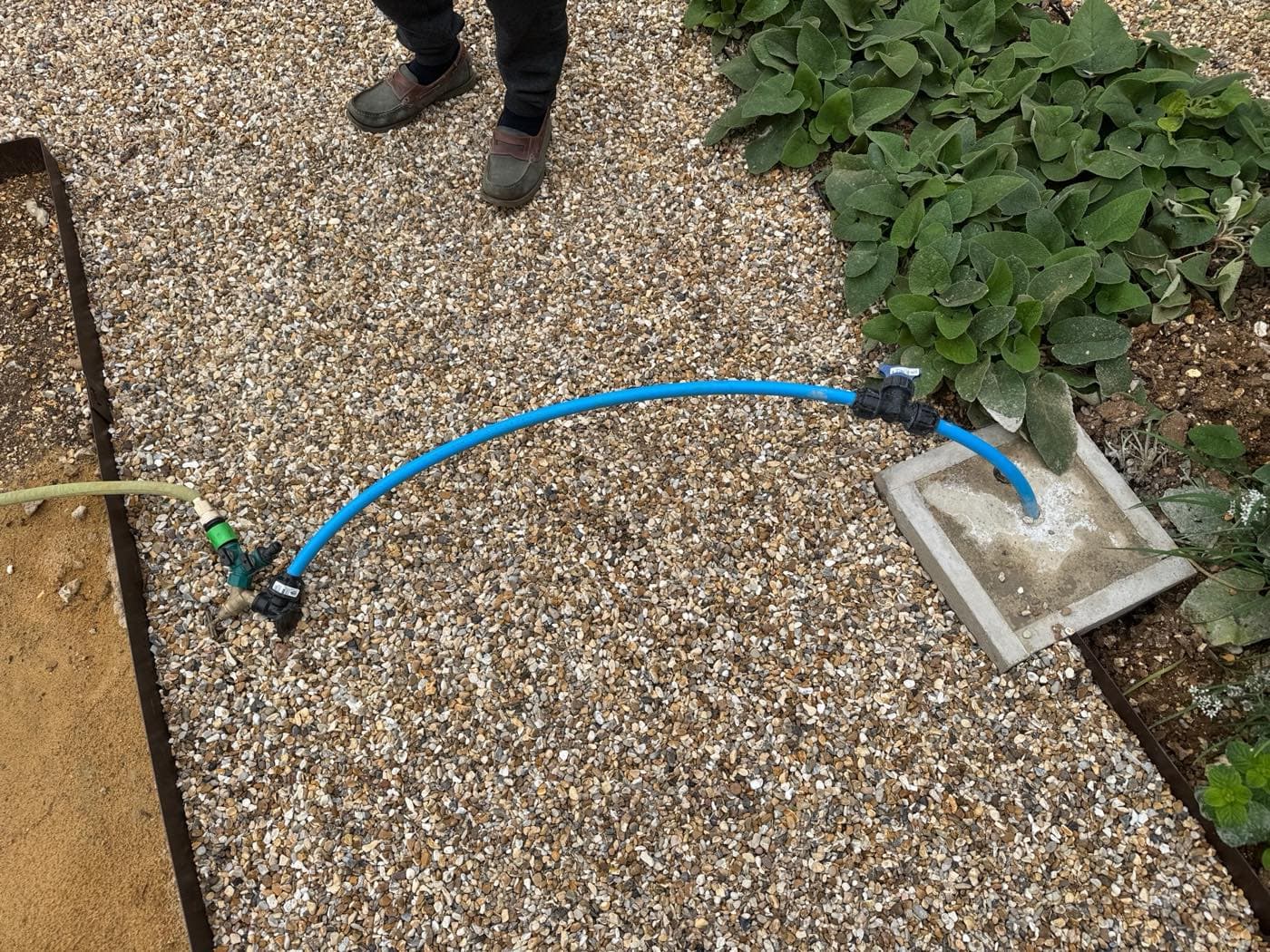
Down the garden on MDPE
For a greenhouse, a stable, a vegetable patch or a car that lives at the far end of the drive. A 25 mm blue MDPE pipe runs from an isolation valve at the house to a standpipe with the tap on it, the same pipe the water company brings your main in on. Buried, it goes below the frost line, about 750 mm, with a drain point so it can be emptied for winter. Where it has to cross a drive or run along a wall it is clipped and lagged instead.
The fittings are cheap. The trench is the job, and so is working round what is already in the ground, which is why this one is quoted after a walk down the garden rather than from a list.
The Five Minutes in October
Every January I replace outside taps that split in the frost, and every one of them could have been saved in October. In this order:
1. Take the hose off
A hose left connected keeps the tap body full of water and gives the ice nowhere to go but through the brass. This one step prevents most of the splits I see.
2. Turn off the isolation valve inside
Quarter turn, usually under the kitchen sink. If it is stiff, work it gently; if it will not move at all, leave it and get it changed before the cold, because a seized valve is no valve.
3. Open the outside tap and leave it open
The water in the short run through the wall drains out, and anything that freezes now has room to expand. Leave it open all winter. An open tap with no water behind it cannot burst.
4. Put a cover on
An insulated tap cover costs a few pounds and slows the frost reaching the body and the wall pipe. It is the belt to the drain-down's braces, not a replacement for it; a cover over a tap full of water just gives you a slower burst.
5. Drain the garden run if you have one
Isolate at the house, open the far tap, open the drain point. Anything left in a buried MDPE run below the frost line will be fine; anything in a lagged run along a wall will not.
If it has already frozen
Do not pour boiling water on it and do not take a blowtorch to it. Turn off the inside isolation valve or the stopcock, open the tap, and let it thaw on its own. If water then runs where it should not, inside the wall or down the inside face, the pipe has split and the emergency shut-off guide covers the next ten minutes. The repair is usually a short one, and this time an isolation valve goes in with it.
What It Costs
| Job | What it involves | Price |
|---|---|---|
| Repair, or like-for-like replacement | A dripping tap re-washered or swapped in the same spot, a split body replaced, a seized isolation valve changed. | From £150 + VAT |
| Move a tap | Same supply, new position on the wall; old hole made good. | From £185 + VAT labour, parts on top |
| New tap where there was none | Isolation and check valves inside, sleeved run through the wall, tap on a plate, tested. Or the MDPE run down the garden. | Fixed price in writing after a look |
| Frozen or burst, water running | Isolate, make safe, repair the split length, fit the missing valve. | From £285 + VAT (payment before dispatch) |
All prices exclude VAT (20%). A new tap is not given a from-price here because going through a cavity wall behind the kitchen sink and trenching MDPE to the end of a garden are not the same job; the outside tap service page has the current starting figures and the written price is fixed before I start. Every job carries a 12-month workmanship guarantee.
What Goes Wrong, and the Honest Fix
Outside taps fail in five ways, and four of them are cheaper to fix than to live with.
| What you see | What it usually is | The fix |
|---|---|---|
| Drips from the spout when it is off | A worn washer, or scale on the seat it closes against | New washer, seat cleaned or reground. Minutes, and it stops the scale stalactite forming |
| Water from the top of the tap when it is on | The gland packing round the spindle has dried out | Gland repacked or the headgear swapped. A tap this age is often worth replacing outright |
| Will not turn, or turns and nothing happens | Scale has seized the spindle, or the washer plate has sheared off it | Replacement tap. Forcing a seized spindle twists the pipe through the wall |
| Wet patch inside the house below the tap | The pipe through the wall split in a frost, or a self-cutting connector is weeping | Isolate, cut out the split, replace with a proper tee and an isolation valve. Then the October routine |
| Hose pressure has dropped to a dribble | A check valve stuck half shut with grit, or the tap fed from a loft tank | Check valve cleaned or changed. If it is tank-fed, the honest answer is a new tap off the mains |
On the self-cutting kits
The DIY outside tap kit works by clamping a saddle onto the cold pipe under the sink and driving a cutter through the copper. It is quick, and for a while it works. Then the rubber seal in the saddle hardens, the joint weeps into the back of the cupboard, and the only check valve on the whole arrangement is the one inside the plastic tap body outside in the frost. I take out several a year. A soldered or compression tee, a quarter-turn isolation valve and a brass double check valve cost little more and are the difference between a tap and a leak with a tap on the end.
Frequently Asked Questions
Does an outside tap need a double check valve?
Yes. A hose on an outside tap can end up lying in a water butt, a pond, a bucket of car shampoo or a puddle of fertiliser, and if the mains pressure drops, that water can be drawn back into the pipes you drink from. The Water Supply (Water Fittings) Regulations treat a hose union tap as that kind of risk and require backflow protection, which in practice is a double check valve fitted on the supply to the tap, inside the house where it will not freeze. A tap sold with a check valve built into the body is a second line of defence, not a substitute, because the body is the part that sits outside in the frost.
How do I stop my outside tap freezing in winter?
Turn off the isolation valve on the inside, then open the outside tap and leave it open so the short run of pipe through the wall drains and has nowhere to hold water. Take the hose off; a hose left connected traps water in the tap body and splits it. An insulated cover over the tap is worth having on top of that, but it is the drain-down that does the work. A tap with no inside isolation valve cannot be drained, and that is the one that bursts.
Why has my outside tap started dripping inside the house?
Nearly always the pipe through the wall froze last winter, split along a seam, and the split only shows once the pressure is back on and the ice has gone. The tap outside looks fine; the leak is in the wall or just inside it. Turn off the inside isolation valve if there is one, or the stopcock if there is not, and it is usually a short repair: the damaged length cut out and replaced, and this time an isolation valve fitted so it can be drained next autumn.
Can I have an outside tap at the bottom of the garden, away from the house?
Yes. The usual way is a run of 25 mm blue MDPE pipe from an isolation valve at the house, buried below the frost line (about 750 mm) or clipped and lagged where it cannot be buried, up to a standpipe with the tap on it. It is the same pipe the water company uses for the main into your house, so it does not corrode and it is cheap per metre. The cost is in the digging and the distance, not the fittings, which is why it is quoted after a look rather than from a list.
How much does it cost to fit or fix an outside tap?
A repair to an existing tap, or a like-for-like replacement in the same spot, is from £150 + VAT. Moving a tap to a new position on the same supply is from £185 + VAT in labour, with the parts on top. A brand-new tap where there was none is priced in writing after a look at the wall and the nearest cold pipe, because going through a cavity wall next to the kitchen sink and running MDPE to the far end of a garden are not the same job. All prices exclude VAT (20%).
Want an Outside Tap Before Spring, or One That Survives This Winter?
A quick look at the wall and the nearest cold pipe, a written fixed price, and a tap with the valves that let it drain. Andover, Marlborough and Hungerford.
Related Guides
Preparing Your Plumbing for Winter
The whole-house version: pipes in the loft, the condensate pipe, the stopcock, and what to do before a cold snap.
Read Guide →Find and Work Your Stopcock
Where it usually is, how to test it before you need it, and what to do if it will not turn.
Read Guide →Low Water Pressure: Causes and Fixes
Why a hose dribbles, what mains pressure you should expect, and when a pump or a new main is the answer.
Read Guide →Need it fixed?
One plumber, from £150 + VAT, price agreed first
Andover, Marlborough and Hungerford, and the villages between. Emergencies from £285 + VAT with payment before call-out, and a real arrival time when you ring.