
Bathroom Extractor Fans Done Properly: A Plumber's Guide
Why the mirror still steams with the fan on, what the regulations actually ask for, who does the electrics, and the ducting that decides whether any of it works.
The extractor fan is the part of a bathroom nobody chooses. It goes in last, it is picked from whatever the merchant has on the shelf, it is wired to the light switch, and the duct is run to wherever was easiest at the time. Then a year later there is black mould in the corner above the shower, the window streams every morning, and the fan is blamed for being too small.
It is almost never too small. This guide is what a bathroom fan actually has to do, what the regulations ask for, why the ducting matters more than the fan, who is allowed to connect it, and what the honest fixes cost. It is written for Andover, Marlborough and Hungerford, where a lot of the bathrooms are in solid-walled cottages that were never built with a fan in mind.
Condensation or a Leak? Read the Damp First
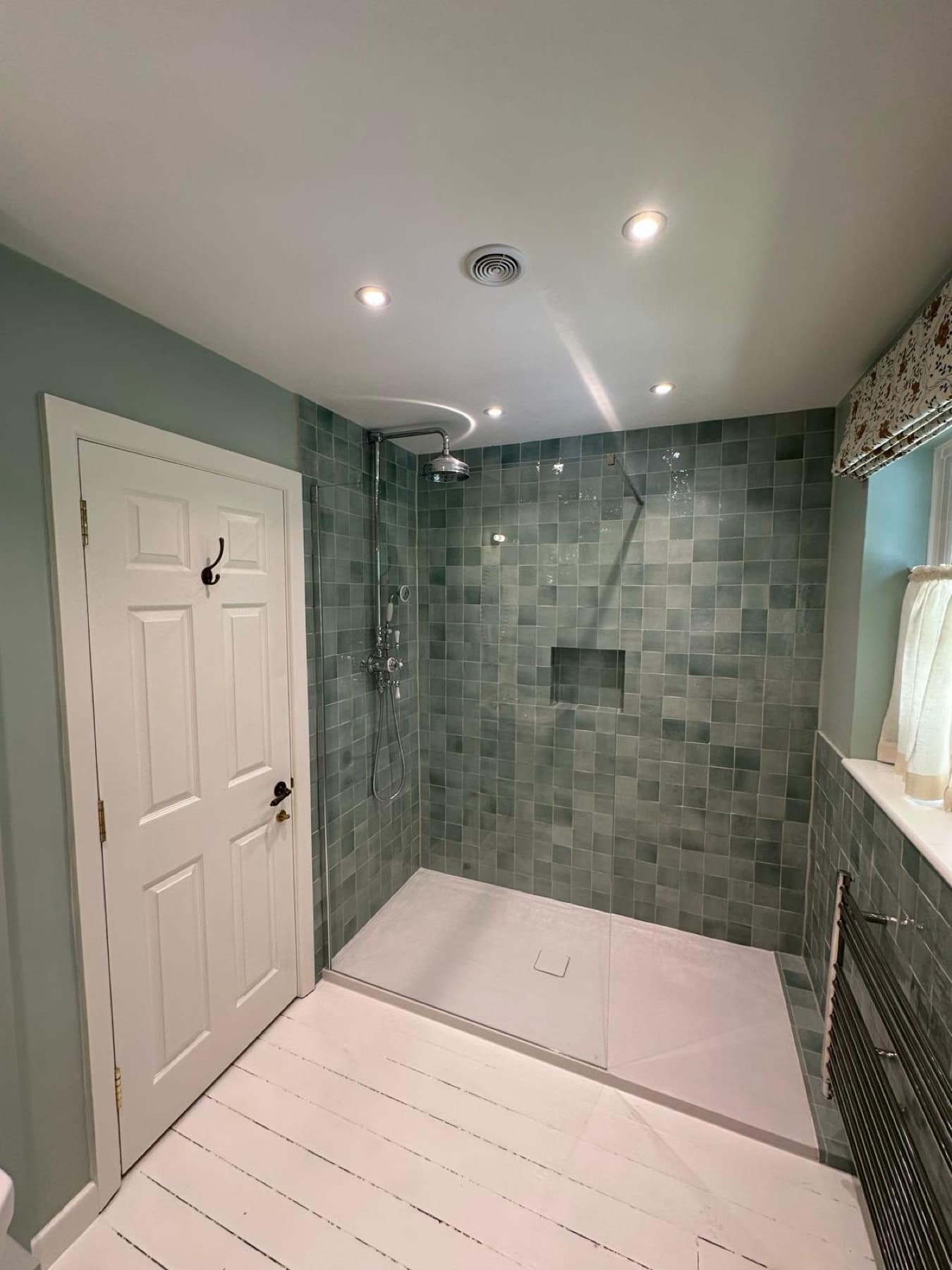
Before anyone buys a fan it is worth being sure the damp is the kind a fan cures. A shower puts a lot of warm, wet air into a small room, and that air drops its water on whatever is coldest: the window, the outside wall, the ceiling corner furthest from the radiator. That is condensation, and ventilation is the answer. A leak looks different and a fan will not touch it.
| What you see | What it usually is | The answer |
|---|---|---|
| Black spots in the ceiling corners, worst above the shower and on the outside wall | Condensation. Warm wet air settling on the coldest surfaces | A fan that runs long enough, ducted to outside, and a lid on the bath or a door on the shower |
| Window streaming every morning, paint lifting off the sill | Condensation. The window is the coldest thing in the room | Same fix. Trickle vents in the window help if the fan has somewhere to draw air from |
| A damp patch on the ceiling of the room below, or at the bottom of the wall behind the bath | A leak: a failed seal round the tray, a weeping waste, a pipe joint | Not a fan job. The leak detection guide covers how it gets found |
| Mould on the wall behind a cupboard or a bath panel, nowhere near the shower | Still air against a cold wall, often a solid outside wall in an older house | Ventilation helps, but so does getting air moving behind the cupboard and keeping the room warm |
| A drip from the fan grille itself on cold mornings | Condensation inside an uninsulated duct in the loft, running back to the fan | Insulated duct, a fall away from the fan, a condensation trap on a vertical run |
The cottage bathroom
A lot of the bathrooms I work in around Great Bedwyn, Ramsbury, Kintbury and the villages off the A343 are in houses with solid brick or flint walls, no cavity, and a bathroom that was a bedroom once. The outside wall is cold all winter, the room is small, and there was never a fan because there was never a shower. Those rooms need the fan more than a modern house does, and they are the ones where the ducting takes the most thought.
What the Building Regulations Ask For
Ventilation in dwellings in England is Approved Document F. For a new bathroom, or one being refitted as part of wider work, it sets a minimum rate the fan has to be capable of. The numbers are the manufacturer's rated extract, and they are the floor, not the target.
| Room | Intermittent fan (runs on demand) | Continuous fan (runs all the time, low rate) |
|---|---|---|
| Bathroom or shower room | 15 litres a second | 8 litres a second |
| Kitchen | 30 litres a second next to the hob, 60 elsewhere in the room | 13 litres a second |
| Utility room | 30 litres a second | 8 litres a second |
| Separate WC | 6 litres a second | 6 litres a second |
Figures from Approved Document F, Volume 1 (dwellings), England. Scotland and Wales have their own documents with similar rates.
No openable window: an overrun
Where the bathroom has no window that opens, the document asks for an intermittent fan to carry on for fifteen minutes after the switch goes off. That is the overrun timer, and it is the single feature that makes the most difference, because the steam is still in the room when the light goes out.
Air has to get in to get out
A fan can only extract what can be replaced. The document expects a gap under the bathroom door, about ten millimetres, so that the fan can pull air through from the landing. A bathroom door that has been fitted with a draught strip or a carpet that fills the gap chokes the fan, and no larger fan will fix that.
Zones, Part P, and Who Does What
A bathroom fan is the one bathroom fitting that is half plumbing and half electrics, and the honest answer is that it takes both trades. Here is where the line falls.
What Will does
- Works out where the fan goes so the duct run is short and reaches outside
- Cuts the ceiling or core-drills the wall, which in a flint or solid brick cottage is the part that needs the right kit
- Runs and supports the ducting, insulates it through the loft, fits the terminal outside
- Fits the fan body or the inline unit and the ceiling valve, and makes good inside and out
- Books the electrician for the same job, so the fan is connected and certified without a second phone call
What the electrician does
- Confirms which bathroom zone the fan sits in and whether the circuit needs RCD protection
- Runs the supply, fits the three-pole isolator outside the bathroom, wires the timer or humidistat
- Tests the circuit and issues the certificate for the work
- Notifies building control where the work is notifiable under Part P, which in a bathroom it usually is
Rosebourne is not Part P registered and never signs for electrical work. You still get a certificate, from the person qualified to issue it.
The zones, briefly
The wiring regulations split a bathroom into zones by how close they are to the water. Zone 0 is inside the bath or tray. Zone 1 is the space directly above it, up to 2.25 metres off the floor, which is where a ceiling fan over a shower sits. Zone 2 runs 600 millimetres out from the edge of that. A fan in Zone 1 has to be rated for it, at least IPX4, and is often a 12-volt low-voltage model with the transformer out of the zones in the loft. A fan on an outside wall across the room, or on the ceiling away from the shower, is outside the zones and the choice is wider and cheaper. Which applies is the electrician's call, so it is settled before the fan is bought, not after.
The Ducting Is the Job
A fan is rated in free air. Every metre of duct, every bend and every crushed section of flexible hose takes some of that away, and the badly ducted fan on the box that says 15 litres a second is moving a fraction of it. Where the duct goes decides whether the room dries.
Rigid where it can be, short everywhere
Rigid round or flat-channel duct moves air with far less resistance than the flexible aluminium hose that comes in the kit. Where flexi is the only option, through a tight loft or round a joist, it is pulled taut and clipped straight, because a slack flexi hose concertinas and every ridge inside it drags on the air. The run is kept as short as the house allows, with as few bends as possible, and a bend made with a rigid elbow rather than a kink.
A 100 millimetre duct is standard for a bathroom fan. An inline fan in the loft, or a kitchen fan, wants 125 or 150 millimetres, and a fan sold with a 100 millimetre spigot pushed onto a long run will never reach its rating.
Through the loft: insulate it
Warm wet air in a cold duct condenses. In a loft, the duct is insulated along its whole length, run with a slight fall away from the fan, and on a run up to a roof tile vent it gets a condensation trap so the water that forms has somewhere to go other than back out of the grille onto the bath mat.
Never into the loft
The duct ends outside. A fan left blowing into the roof void, which is how a lot of loft en-suites were finished, puts a shower's worth of water into the insulation every morning. The signs are damp insulation above the bathroom, a stained ceiling and mould on the felt. Extending the duct to a tile vent or soffit grille is one of the commonest fan jobs I do.
The terminal outside
A wall grille with a backdraught shutter, a soffit vent, or a roof tile vent matched to the tile. The shutter matters: without it the fan is a hole in the wall and the bathroom is the coldest room in the house all winter. A terminal that has been painted over or filled with a bird's nest is a surprisingly common reason a fan stops working.
Solid walls and listed houses
A flint or solid brick wall is core-drilled with a diamond core, not chased. On a listed house or in a conservation area, where a grille goes on the front elevation can matter, and it is worth a word with the conservation officer before the drill comes out; a soffit or a discreet tile vent at the back is often the answer that pleases everyone.
Choosing the Fan
With the duct run settled, the fan is the easy part. These are the types, and which one fits which bathroom.
| Type | Where it suits | Worth knowing |
|---|---|---|
| Axial wall or ceiling fan | Fan on an outside wall, or on the ceiling with a short straight run to the terminal | The standard bathroom fan. Cheap, simple, but loses its rating quickly on a long duct |
| Centrifugal fan | Inside wall or ceiling, with a duct run of a few metres to reach outside | Pushes against duct resistance where an axial fan gives up. Slightly louder for it |
| Inline fan in the loft | Loft en-suites, fans over a shower, anyone who wants it quiet | The motor is in the loft and only a valve is in the room, so it is quiet and the Zone 1 question often goes away. The best answer for most shower rooms |
| Continuous (dMEV) fan | Bathrooms with a stubborn mould problem, or where nobody will ever remember the switch | Runs all the time at a trickle and boosts when the humidity rises. Costs pennies to run and keeps the room dry without anyone thinking about it |
Overrun timer
Keeps the fan going after the light goes off. The feature that does the most for the money, and the one the document asks for in a windowless room.
Humidistat
Switches the fan on when the air gets wet and off when it is dry, whether or not the light is on. Good in a bathroom used by teenagers.
Noise
The spec sheet gives a sound level at three metres. Compare that figure between models rather than the word "silent" on the box, and if quiet matters, go inline.
I fit fans from the makers whose spares and spec sheets are easy to get hold of, which for bathroom fans means Manrose, Xpelair and EnviroVent. The extractor fan service page has more on each.
What It Costs
| Job | What it involves | Price |
|---|---|---|
| Fan not clearing the room: a look | Fan checked, duct run traced, terminal cleared, the honest answer on whether it is the fan, the duct or the door gap. | From £150 + VAT |
| Duct put right | A fan venting into the loft extended to a tile vent or soffit; a crushed flexi replaced with rigid and insulated; a condensation trap added. | Fixed price in writing after a look |
| New fan where there was none | Position, hole, duct, terminal, fan or inline unit, making good. The electrician's connection and certificate are booked alongside and priced by them. | Fixed price in writing after a look |
| As part of a bathroom refurbishment | Fan and ducting designed in at first fix, when the ceiling is open and the duct can go where it should. | Priced within the bathroom quote |
All prices exclude VAT (20%). A fan is not given a from-price here because a ceiling fan with a metre of duct to the soffit and an inline unit in a loft with a tile vent through a slate roof are not the same job; the extractor fan service page has the current starting figures and the written price is fixed before I start. Every job carries a 12-month workmanship guarantee on my work; the electrician's certificate covers theirs.
What Goes Wrong, and the Honest Fix
| What you notice | What it usually is | The fix |
|---|---|---|
| Fan runs, mirror still steams | Long or crushed duct, vents into the loft, or no gap under the door | Trace the duct, fix the run, plane the door. Rarely a bigger fan |
| Mould comes back every winter | Fan on the light switch, runs three minutes, stops with the steam still in the room | An overrun timer or humidistat model, wired by the electrician |
| Drips from the grille on cold mornings | Condensation in an uninsulated loft duct running back to the fan | Insulate the duct, fall it away from the fan, add a trap |
| Rattles or hums | A worn bearing, a loose backdraught shutter, or the body not fixed to anything solid | Shutter re-seated, body fixed; a worn motor is a new fan |
| Cold draught through the fan with it off | No backdraught shutter, or one stuck open with dust | Shutter fitted or cleaned at the terminal |
| Fan trips the electrics | Water in the fan, or a fault on the circuit | The electrician, first. I come after if the duct turns out to be the reason water got in |
On the 100 millimetre kit from the shelf
The boxed fan with three metres of flexi hose and a plastic grille is fine for one job: an outside wall, a straight run through it, a grille on the other side. Pushed into a loft and left pointing at the insulation, which is how I most often find it, it is a damp problem with a motor. The fan is rarely the thing that needs replacing. The duct is.
Frequently Asked Questions
Do I need an extractor fan in my bathroom?
If the bathroom is new, or you are refurbishing it, yes. Approved Document F of the Building Regulations in England asks for extract ventilation in a bathroom, which in practice means a fan rated for at least 15 litres a second running on demand, or a continuous fan at a lower rate. An openable window on its own is not enough in a new bathroom. In an older bathroom that was never fitted with one, nothing forces you to add a fan, but the black mould in the corner above the shower usually does.
Why does my mirror still steam up with the fan running?
Nearly always the ducting rather than the fan. A fan that pushes air into a long run of crushed flexible duct, or into the loft rather than outside, moves almost nothing however loudly it runs. The second cause is time: a fan on the light switch runs for the three minutes the light is on and stops before the steam has cleared. A fan with an overrun timer or a humidity sensor keeps going until the room is actually dry.
Can a plumber fit a bathroom extractor fan?
Partly. Will does the position, the hole through the ceiling or wall, the ducting to the outside, the terminal and the making good. A fan in a bathroom is electrical work in a special location, and in England that is notifiable under Part P, so a qualified electrician connects it, fits the isolator, tests it, issues the certificate and notifies building control. Rosebourne is not Part P registered and does not claim to be. The two visits are booked together so you get one job, not two.
What is Zone 1 and why does it matter for a fan?
The wiring regulations divide a bathroom into zones by how close they are to water. Zone 1 is the space directly above the bath or shower tray up to 2.25 metres. A fan fitted there has to be rated for it, at least IPX4, and is often a 12-volt low-voltage model with its transformer outside the zones. A fan on the ceiling away from the shower, or on an outside wall across the room, is outside the zones and the choice is wider. The electrician confirms which applies before anything is bought.
My fan drips water in winter. Is the roof leaking?
Usually not. Warm wet air leaving the bathroom meets a cold length of duct in the loft, condenses on the inside of it, and runs back down to drip out of the grille. The fix is insulated ducting through the cold space, a slight fall away from the fan, and on a long vertical run a condensation trap. If the drip is there when nobody has showered for a day, then it is worth looking at the roof, and the leak detection guide covers that.
Can a fan in a loft en-suite just vent into the loft?
No, and a surprising number do. Venting into the loft puts a shower's worth of steam into a cold roof space every morning, which ends as damp insulation, stained ceilings and mould on the underside of the felt. The duct has to reach outside air: a tile vent, a soffit grille or a wall terminal. Moving a fan that vents into the loft so that it vents outside is the commonest fan job I do.
A Fan That Vents Into the Loft, or a Bathroom That Will Not Dry?
A look at the room and the duct run, a written fixed price, and an electrician booked for the same job. Andover, Marlborough and Hungerford.
Related Guides
Bathroom Renovation: What to Expect, Week by Week
Where the fan and its duct go in the order of a refurbishment, and why first fix is the moment to get it right.
Read Guide →Leak Detection: Finding Water Where It Should Not Be
When the damp is not condensation. How a leak behind a bath or under a tray gets traced.
Read Guide →Preparing Your Plumbing for Winter
The cold months are when condensation bites hardest. The whole-house checklist before the first frost.
Read Guide →Planning bathroom work?
Three fixed-price packages, one written quote
A refresh from £1,800 + VAT, a bath-to-shower conversion, or a full bathroom we supply and fit. Free survey, fixed price, 12-month guarantee.