
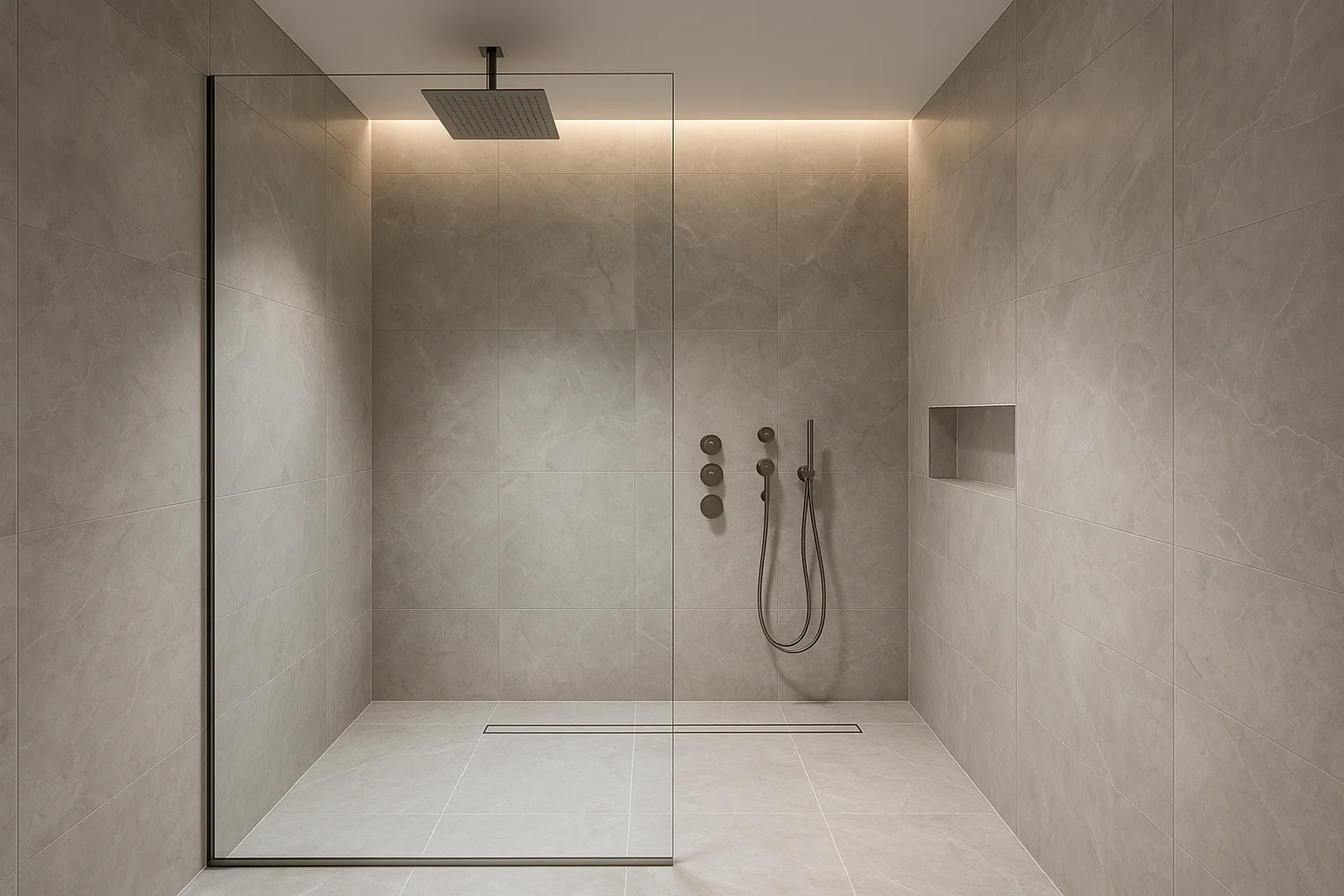
What is dark showering?
Dark showering is exactly what it sounds like: taking your evening shower with the lights off or turned right down. Some people use a single candle. Others use a dim night light or leave the door ajar so a hallway glow creeps in. The idea gained traction on TikTok through 2024 and 2025, and has since been picked up by outlets from House Beautiful to Fox News Health.
The principle draws on something older than social media. Traditional Japanese bathing rituals and Ayurvedic evening practices have long valued low lighting as part of the wind-down to sleep. Dark showering is, in many ways, a modern shorthand for an ancient instinct: when the light fades, the body prepares for rest.
The trend has been described by some wellness commentators as particularly helpful for people who find it hard to switch off — those with busy minds, screen-heavy evenings, or difficulty falling asleep. But what does the evidence actually say?
What the science plausibly supports
Dark showering itself has not been studied in any peer-reviewed clinical trial. No researcher has compared dark-shower sleepers against well-lit-shower sleepers in a controlled setting. That is worth being honest about.
What has been studied — quite thoroughly — are the two things dark showering combines:
1. Warm water before bed
A 2019 systematic review from the University of Texas at Austin, covering over 5,000 studies, found that bathing or showering in warm water (40–42.5 °C) one to two hours before bed shortened the time it took to fall asleep by an average of 10 minutes. The mechanism is thermoregulatory: warm water draws blood to your hands and feet, which then radiate heat and help your core temperature drop — mimicking the natural pre-sleep cooling cycle.
2. Reduced light exposure in the evening
A Harvard/Brigham and Women’s Hospital study found that ordinary room lighting (under 200 lux) suppressed melatonin production by over 70% compared to dim conditions. Melatonin — often called the “hormone of darkness” — normally begins rising about two hours before sleep. Bright bathroom lighting delays that onset. Switching to dim or amber-toned light in the evening aligns with NHS guidance to keep your sleep environment “quiet, dark and cool.”
Safety first: candles, slips, ventilation
The romantic image of showering by candlelight deserves some sober qualification.
Candles
The London Fire Brigade explicitly warns against candles around bath edges — tea lights can reach temperatures that melt plastic surfaces. Over 50 candle-related fires occur daily in the UK, peaking in winter months. The Brigade recommends LED flameless candles as a safer alternative. They come in flickering, rechargeable, and waterproof versions that produce the same warm glow without the fire risk.
Slips and falls
Falls cause nearly 450,000 A&E attendances in England each year, and bathrooms are consistently identified as one of the most accident-prone rooms. Dr Allie Hare, a sleep medicine consultant at the Royal Brompton Hospital, recommends dim lighting rather than total darkness. A low-lux warm-toned light provides enough visibility to move safely while still supporting melatonin production.
Ventilation
UK Building Regulations (Approved Document F) require bathrooms to have mechanical extraction — a fan pulling at least 15 litres per second. If your extractor fan is noisy or annoying enough that you switch it off during your dark shower, you risk condensation build-up and eventually mould. A quiet, well-installed fan is part of the equation, not an obstacle to it.
How to try it tonight (no tools required)
You do not need to buy anything to experiment with this. Here is a straightforward checklist:
- 1Time it right. Aim for 1–2 hours before your intended bedtime. This gives your core temperature time to drop after the shower.
- 2Dim the lights. Switch off the main bathroom light. Leave the landing light on with the door ajar, or use a phone torch on its lowest setting facing away from you. Even a nightlight plugged into a socket works.
- 3Warm, not hot. Aim for comfortably warm water — roughly 40°C. Scalding water raises your heart rate rather than calming it.
- 4Keep it short-ish. 10–15 minutes is enough. You are not trying to meditate; you are letting your body cool down afterward.
- 5Leave the fan on. Even if it is a bit noisy. Condensation is worse than a slight hum.
- 6Skip the phone. The screen undoes the low-light benefit. If you want sound, use a small speaker with a calm playlist.
- 7Pat dry, stay dim. Keep the lighting low as you dry off and move to bed. Switching on bright lights afterward reverses the melatonin benefit.
When your bathroom fights you
The dark showering guides on TikTok tend to assume a cooperative bathroom. In practice — especially in homes across Andover, Marlborough and Hungerford — the bathroom itself can be the obstacle:
Harsh ceiling downlights
Many bathrooms in this area were fitted with 4,000K+ cool-white LED downlights during renovations. They are brilliant for morning routines but actively suppress melatonin in the evening. If your lights are all-or-nothing, dark showering means standing in pitch black or under a surgical glare — neither is ideal.
Temperature spikes and cold snaps
Older pressure-balanced valves or combi boilers with inconsistent flow can cause sudden temperature swings when someone runs a tap elsewhere. A thermostatic mixing valve holds temperature steady regardless of demand changes — and temperature stability is part of what makes the warm-water benefit work.
Noisy pipes and water hammer
Banging pipes when taps close, whistling from undersized supply lines, or a rattling extractor fan all shatter the calm that dark showering is supposed to create. These are fixable plumbing issues, not features of your home.
Poor extraction
If your extractor fan sounds like it is powered by a rubber band, you will want to turn it off — and then you get condensation, mould, and peeling paint. A quiet, correctly specified fan (ideally with a humidity sensor and overrun timer) keeps the air clear without breaking the mood.
Upgrades that genuinely help
If you find dark showering genuinely improves your evening routine and you want to make it easier, these are the upgrades worth considering — roughly in order of cost:
Warm-white IP-rated LED strip or niche light
A 2,700K or lower LED strip in a shower niche or behind a floating vanity gives a soft amber glow without needing candles. Must be IP65-rated if within Zone 1 (above the shower up to 2.25m). From around £30 for the strip, plus installation.
Dimmer circuit for existing bathroom lights
If your existing downlights are dimmable-compatible, adding a dimmer switch or smart dimmer lets you dial the lighting down in the evening and back up for the morning. A qualified electrician can install this.
Thermostatic shower valve check and replacement
If your shower temperature wanders, the cartridge may need replacing — or the whole valve may benefit from an upgrade to a modern thermostatic unit. Temperature stability is central to the warm-water sleep benefit.
Anti-hammer arrestors and pipe securing
Water hammer (the loud bang when taps close) is usually fixable with arrestors fitted to the supply line, or by securing loose pipework. A small job that makes a big difference to a calm bathroom.
Quiet extractor fan with humidity sensor
Modern fans run at under 30 dB — quieter than a whisper. A humidity sensor means the fan activates and deactivates automatically, so you never need to think about it.
Rainfall shower head
A larger-diameter head with a gentle, even flow pattern feels more immersive and relaxing than a narrow jet. Check your water pressure supports it first — we can advise on that.
Want us to set your bathroom up for calmer evenings?
We have put together a Sleep-Optimised Shower Setup service — three tiers, from a tune-up of what you already have (from £350) through to a full calm-bathroom refurbishment. Warm lighting, stable temperature, quiet extraction, and practical safety measures — tailored to your home.
Further reading
- Haghayegh, S. et al. (2019). “Before-bedtime passive body heating by warm shower or bath to improve sleep.” Sleep Medicine Reviews, 46, 124–135. PubMed: 31102877
- Gooley, J.J. et al. (2011). “Exposure to room light before bedtime suppresses melatonin onset and shortens melatonin duration.” Journal of Clinical Endocrinology & Metabolism, 96(3), E463–E472. PMC: 3047226
- NHS Every Mind Matters — How to fall asleep faster and sleep better
- Sleep Foundation — Do Showers Before Bed Help You Get More Sleep?
- London Fire Brigade — Candle safety at home
- GOV.UK — Approved Document F: Ventilation
Related guides
Complete Bathroom Services Guide
Everything we offer for bathrooms across Andover, Marlborough & Hungerford.
Read more →Shower Installation Guide
Electric, mixer, power and digital showers — installation options and pricing.
Read more →Bathroom Renovation Guide
Costs, timelines and practical tips for homeowners in Andover, Marlborough and Hungerford.
Read more →